You would think we would have made the connection between cruise ships and the crowds on Capri, but we didn’t. So, still clueless, we headed out to Pompeii on the Circumvesuviana Rail Line. You can get this train from the main “Garibaldi” station in the heart of the city. It was walking distance for us, although I have to admit we wimped out and took a cab.
This is a suburban commuter train with several lines, cheap and un-airconditioned, that connects among other places, Sorrento with Naples. Along this line you can get off at Herculaneum (Ercolano) and Pompeii (Pompei). The trip costs 2.60 euro each way, a bargain, and takes about 35 minutes. You get out at the stop Pompei, Villa dei Misteri. Then you wander about in a state of confusion for a few minutes, while hawkers size you up, figure out your native language, and yell at you in your language that there are tours in (insert language here).
On the train, it was hot and crowded, and we were treated to the sight of very run-down apartment blocks and abandoned buildings, covered often with graffiti at the beginning of the trip. Gradually the buildings became cleaner and more comfortable-looking, and the Bay of Naples appeared in the near distance. A group of Roma (I think) got onto the train with a boom box, and kept time to the very loud music with tambourines and bongos. It was deafening, and the Italians rolled their eyes as a man moved down the aisle holding a plastic cup and asking for money. The tourists avoided looking at him and held onto their bags, unnecessarily, I thought. I rocked back and forth, trying to catch the breeze from the half-opened windows.
When we arrived and walked the short distance to the entrance, we found a very long line already in place. Our friends were disgusted, and said there was no way they were waiting that long in the heat, but Tom and I really wanted to see the excavations, so we queued up, and immediately discovered that we were moving quickly. As well as that, you could hide under the adjacent hedge and escape the worst of the heat. I hid.
Admission is 13 euro, free for EU citizens under 25. We got an official map, bought a guide book and set out.
You have to watch your step on the ancient stones of the street, which also has a sidewalk on both sides, here and there with modern repairs. Pedestrians could use stepping stones set at intervals, to cross the street during flooding, or to avoid dirt and manure from animals. In many places, the ruts left by centuries of carts are still visible. (The pattern of the street paving stones is similar in Italian cities today – stones are placed at angles, which makes it safer for wheels to avoid getting stuck in parallel ruts. I saw this in Florence in the old city as well.)

We walked down the main street, which led to the Forum, a huge space. The size of it surprised me at first, until I considered that this was really the political and business center of the city, and its size indicated its importance. Some of the original marble paving was still intact, in other places simpler stone paving. We found one of the biggest complexes of baths, with separate areas for men and women. The ceilings were intact here, and considerable remains of beautifully delicate carvings and wall paintings.
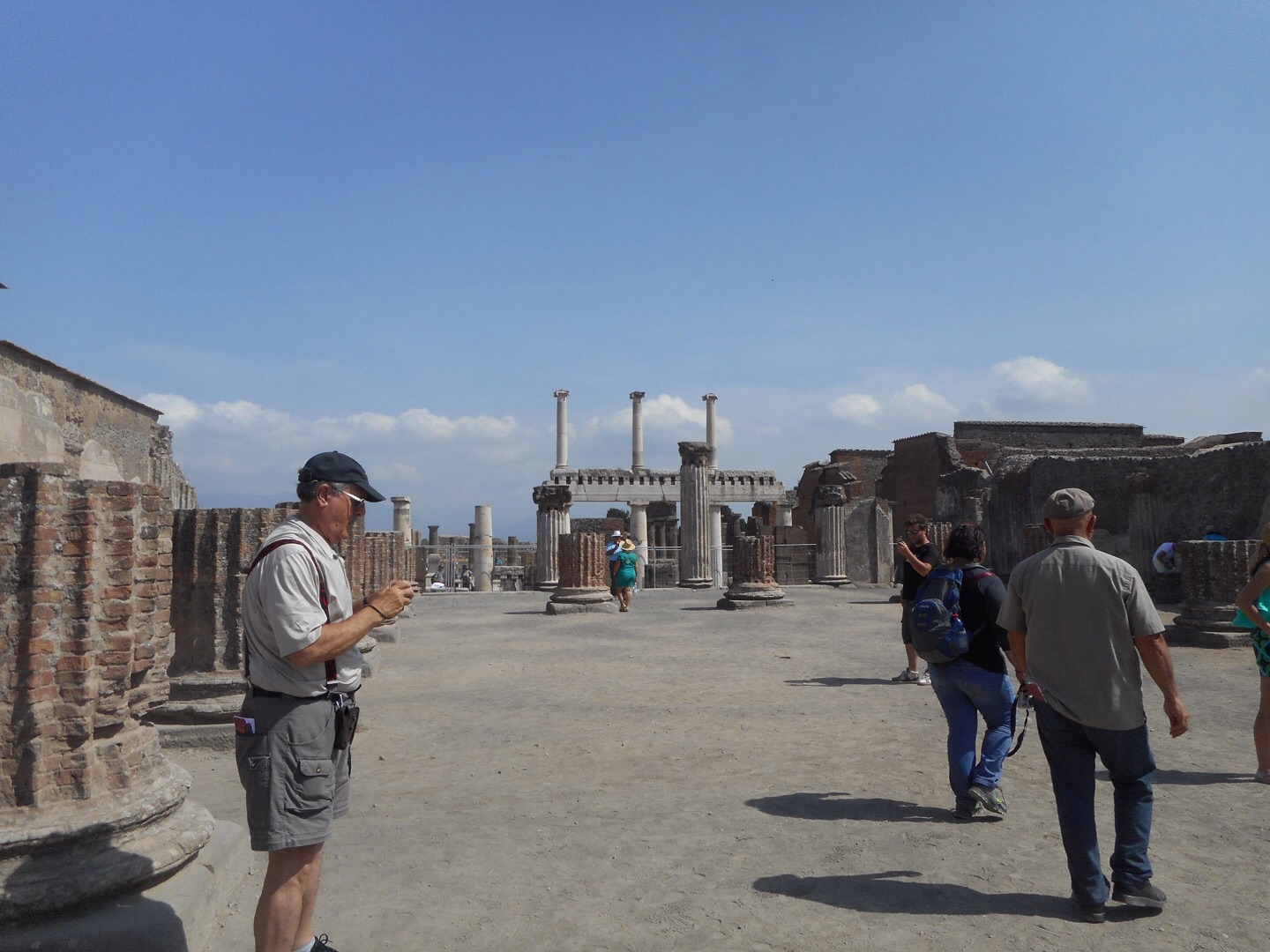 The Forum

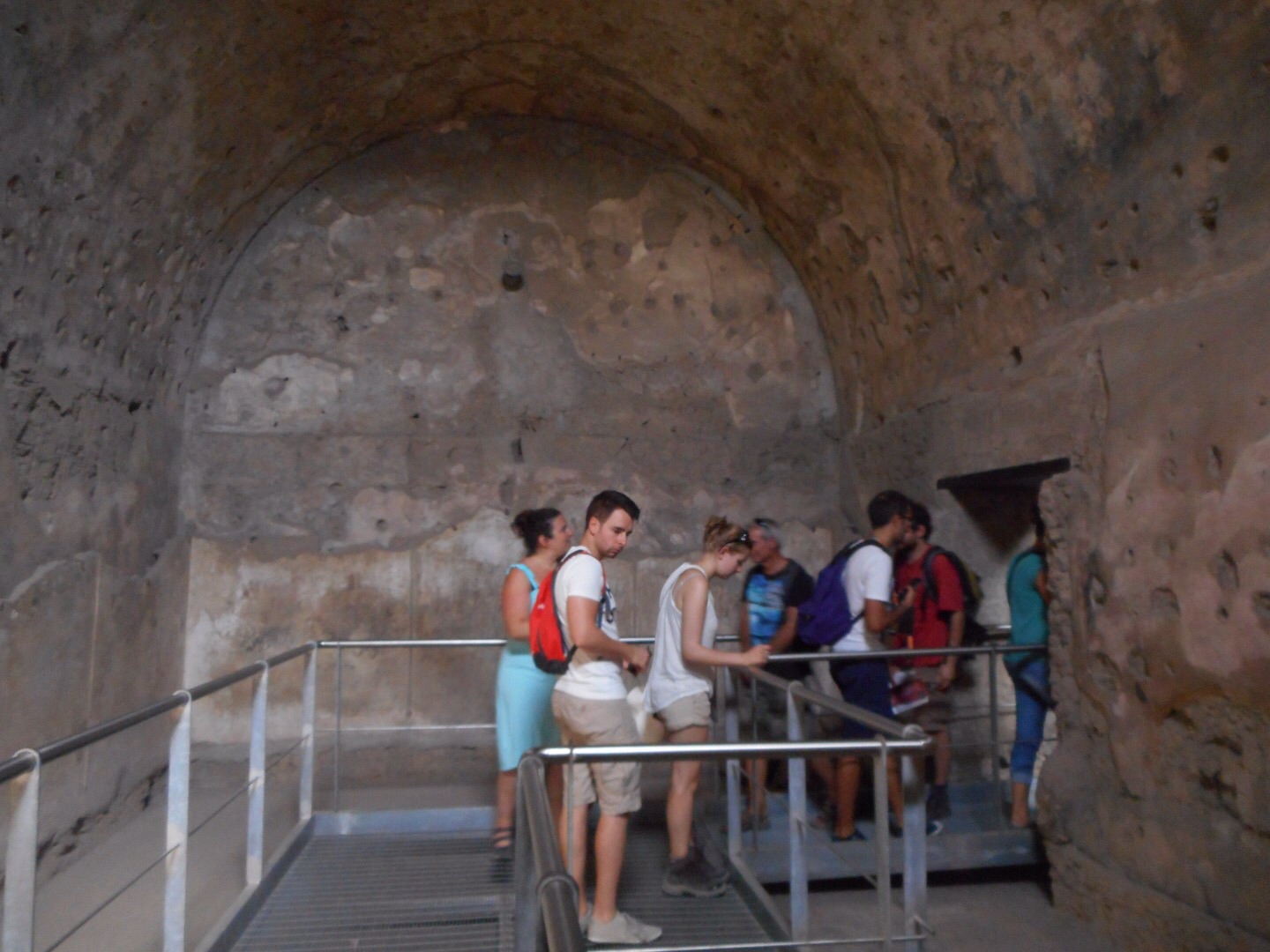
The Baths
Outside was the remains of a swimming pool, originally a meter and a half deep.
There was a remains of a restaurant/snack bar, with the serving counter inset with terracotta pots for the food. An area in the back would have offered a seating area for customers, and the owner and his family would probably have lived upstairs. I imagined the seating area, which was not roofed, covered with an arbor of vines for shade.
It was hard to figure out what was what. One map had numbers of buildings up to 45, and we found buildings with numbers into the 60’s. Then we found the same number again on a different building. We gradually realized that the city, for modern interpretation, is divided into sections. I have no idea if this corresponds to an original way of figuring addresses. We were both confused, and wondered if we should have got a tour.
There were crowds everywhere. Masses of people were trotting along behind guides with umbrellas or other long items held aloft for identification. I hate the idea of tours. We tried to get to see the brothel, obviously a highlight for tours, but the lines were too long and we were too hot. The reality of the cruise ships started to dawn on us.


Amphitheater Great Palestra
We did see the larger amphitheater. Unfortunately, a rather ugly plywood pyramid had been built smack in the middle, with an exhibition of art inspired by Pompeii, but its placement made it impossible to get a good all-round view of the theater. Behind it was the Palestra, the Roman equivalent of organized youth sports, where young men got exercise, learned sports, and were taught to value Roman and Imperial ideals.
 The necropolis
We found the necropolis at the edge of the city, and tried to discipher the inscriptions with our high school Latin, with limited success. I was amazed I could figure out anything, and thought nice things about my Latin teacher.
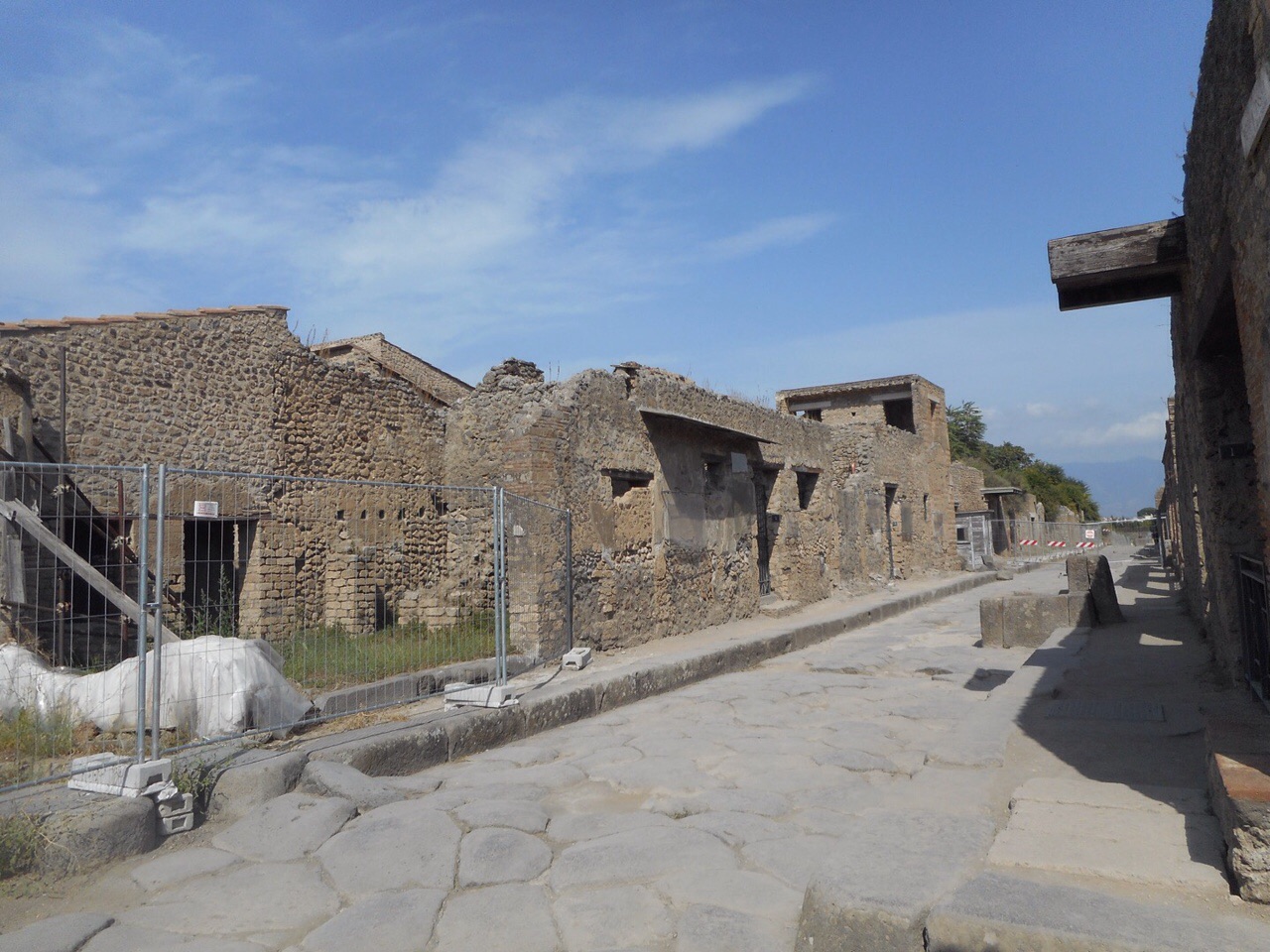
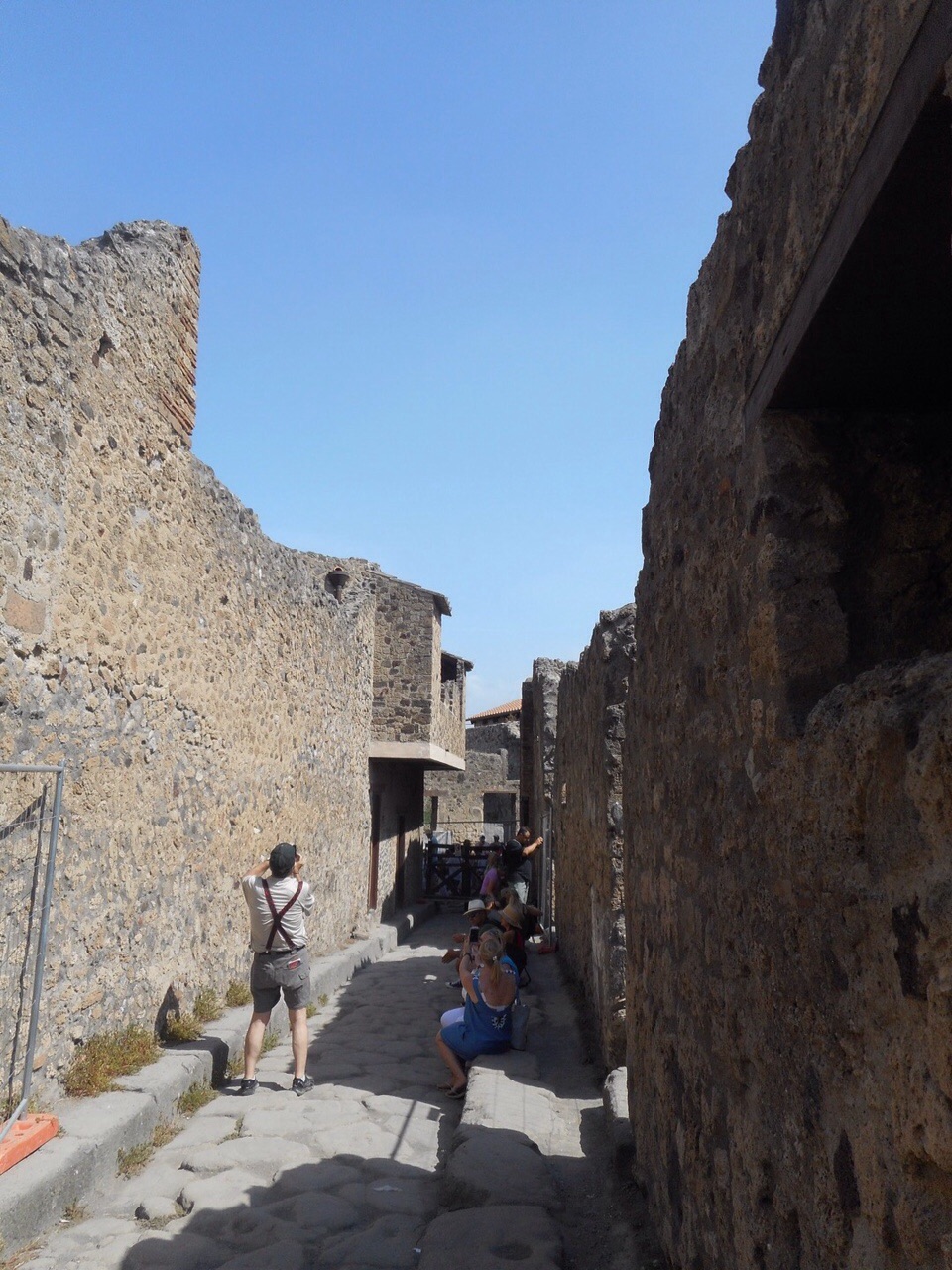
The crowds were thinning out, so we could finally get some good photos of the streets of the city, much more evocative without crowds of modern tourists. I had got to the end of my tether, and Tom wasn’t looking too good either. We followed the exiting masses and got some cold drinks before climbing back onto the Circumvesuviana, and heading home to our apartment.
 amsolomon18