Day 17: UNESCO site Matera, the cave-dwellers

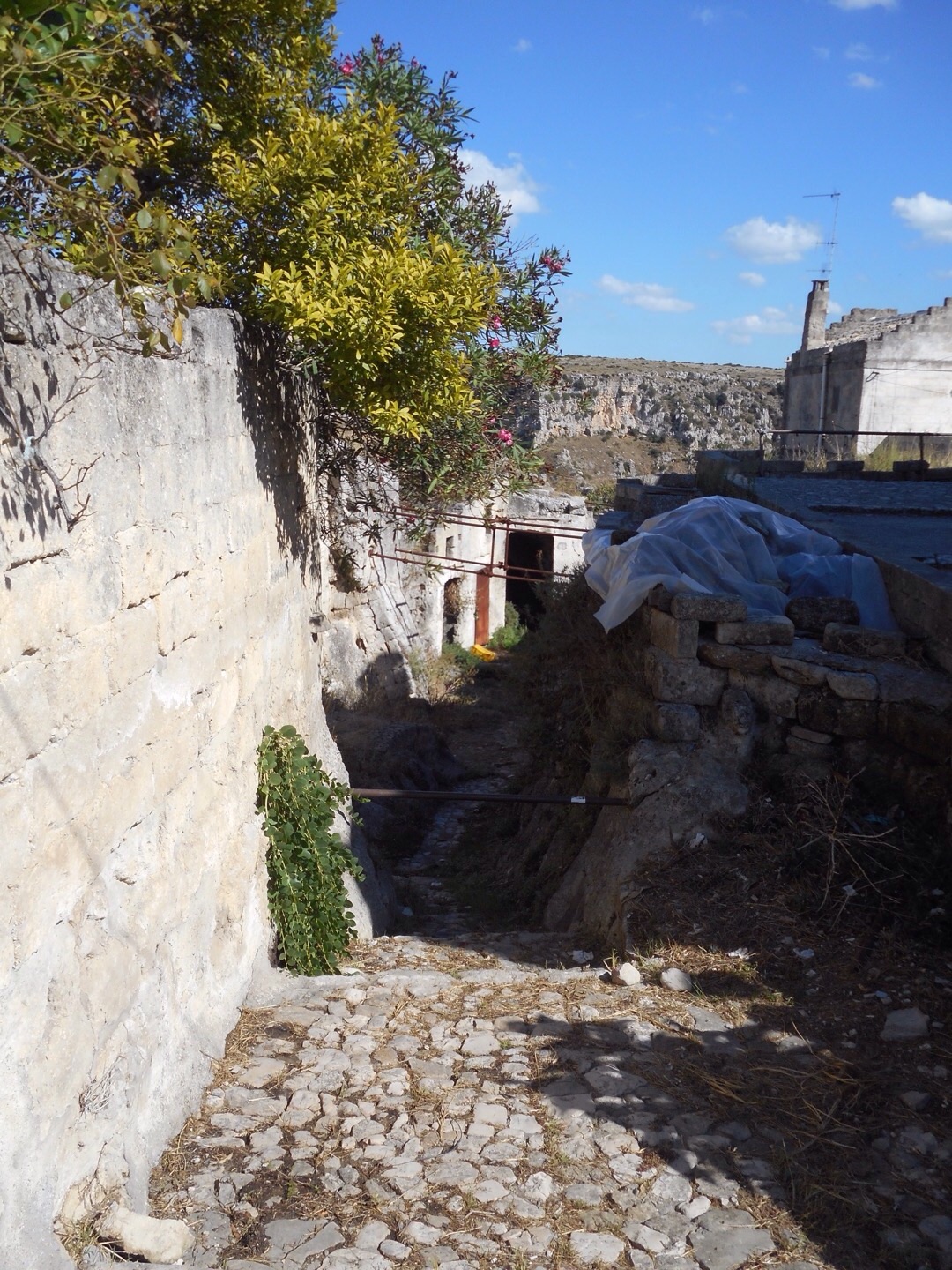
Matera is one of the most interesting sites in Italy, if you enjoy history.  The town is literally 9000 years old, one of the oldest in the world.  It is home to one of the earliest sites of human habitation in Italy, and is now protected as a UNESCO World Heritage Site.  Because it’s a living town, there’s no admission free, and no waiting times. There’s a public parking garage about two blocks away from the site, and an official information booth where they give out maps is right on the corner by the garage.
image

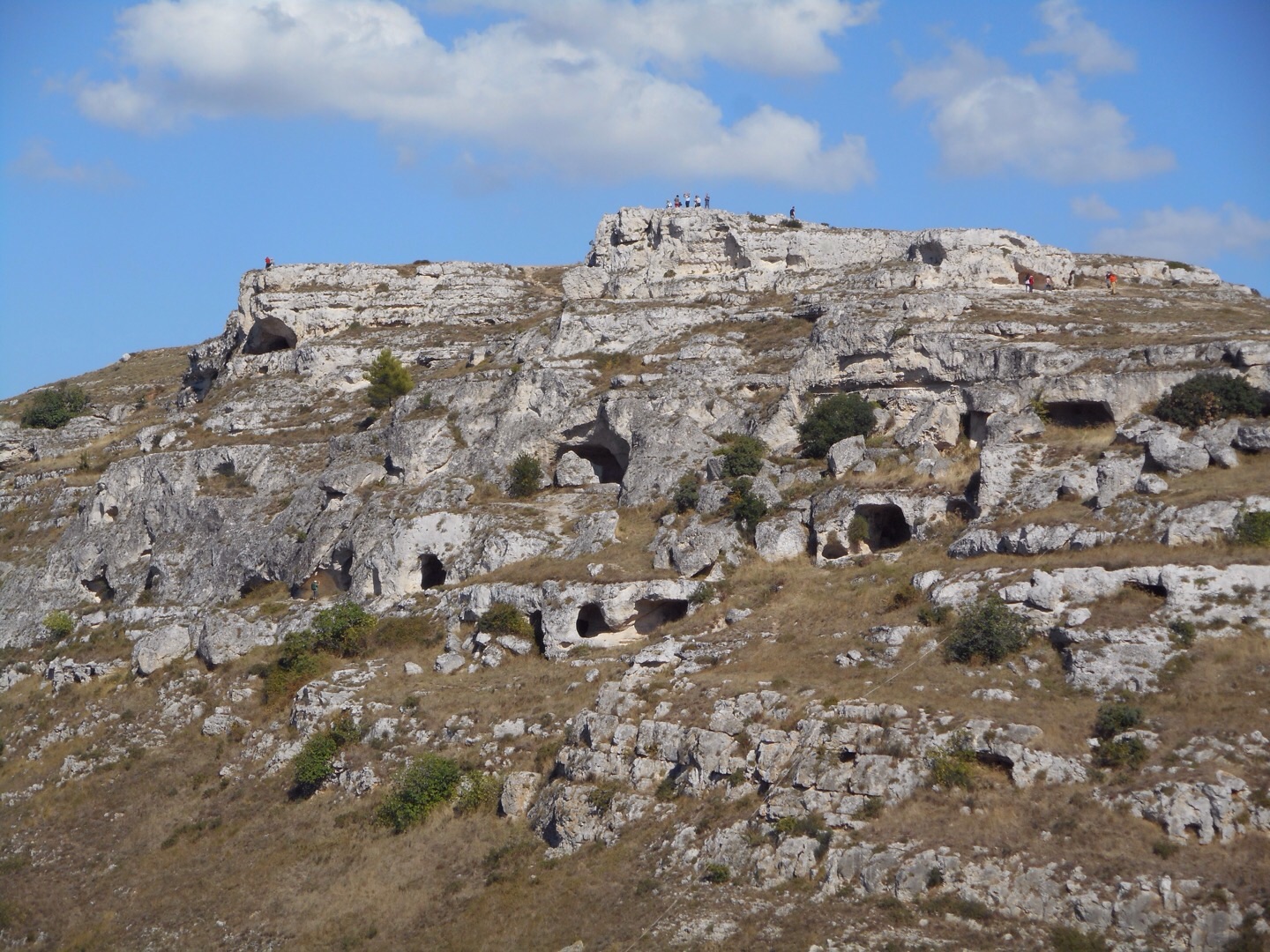
Across the valley, you can still see some of the caves, that were abandoned centuries ago.  People started living in the caves, and just never left the area.  They just kept improving their housing.

image image

What’s even better about it, is that it is still inhabited.  No thanks to the Italian Government, which tried to move out all the residents in 1952, embarassed by the poverty there, and the possibility that this was not the image they wanted of modern Italy.  Luckily, a lot of people refused to move.

image  image

The settlement started with people living in caves, which they hollowed out and improved as the centuries passed.  When they learned to work wood, they made doors;  when they learned how to built cisterns under the floor, they built cisterns which held the rainwater for the families within.  It may be the only place in the world where a person can boast of living in the same place as his forebears from 9000 years ago.

Some of the habitations look half like caves, and half like stone houses, with typical Italian red roofs, chimneys, and even TV aerials sprouting from the roofs.  No satellite dishes that I saw.  It’s clear that people make themselves comfortable with outside seating areas, modern doors and windows and build extensions onto their houses with the same stone.

image

One part of the “Sassi”, as it’s called is all residential, with a few small restaurants along the main road to cater to tourists.  Another area, still built out of the caves, contains hotels and businesses.

One of the caves, not lived in any more, has been outfitted with the household goods that were used here in the 19th and early 20th centuries.  There would have been one large bed for the couple, and a few pieces of furniture, mostly with large drawers which would be used as beds for small children.  A hen and her chicks would live under the raised bed, and there was a small stable area for a donkey or mule, and perhaps a goat.

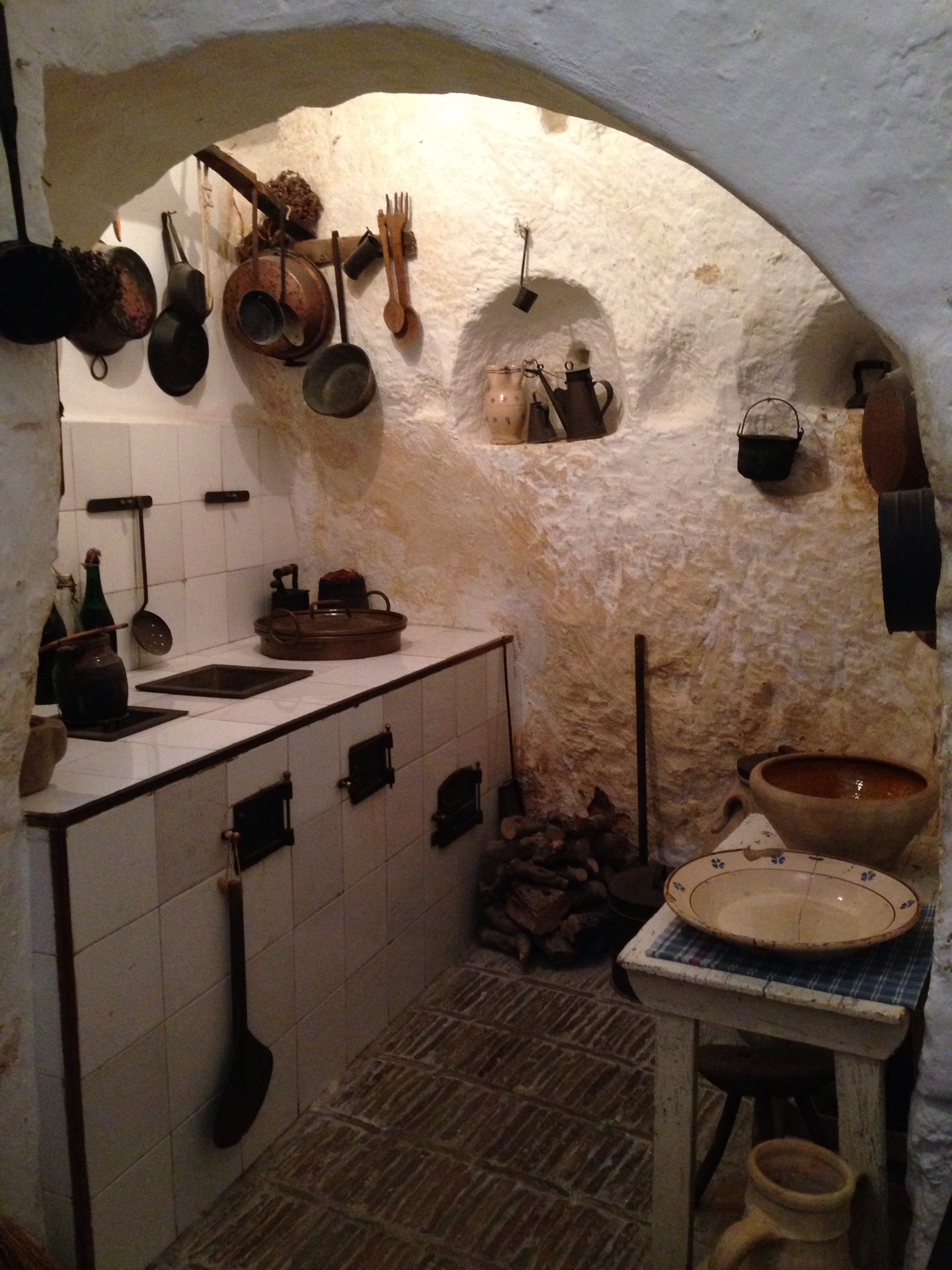
image image

Churches are also carved out of the rock, and contain frescoes which are still quite beautiful.  In one church, I saw frescoes dating back to the 11th century.  Photography was forbidden, and there was a small entrance fee to this and some other sites, to aid with preservation.  These “Ruperian churches” can be found around the area, although we didn’t have time to discover exactly where, but I did see a sign as we left the town, advertising a church with a tour bus pulling into the driveway.

In another cave, the people had stored snow during the winter months for use in healing and relief from the heat in the summers.  Clean snow was kept for the humans and the dirtier snow for animals.

It is a fascinating site, well worth a visit, and took us so far south that on our way back we saw the Gulf of Taranto in the distance, the body of water between the toe and the heel of the boot of Italy.

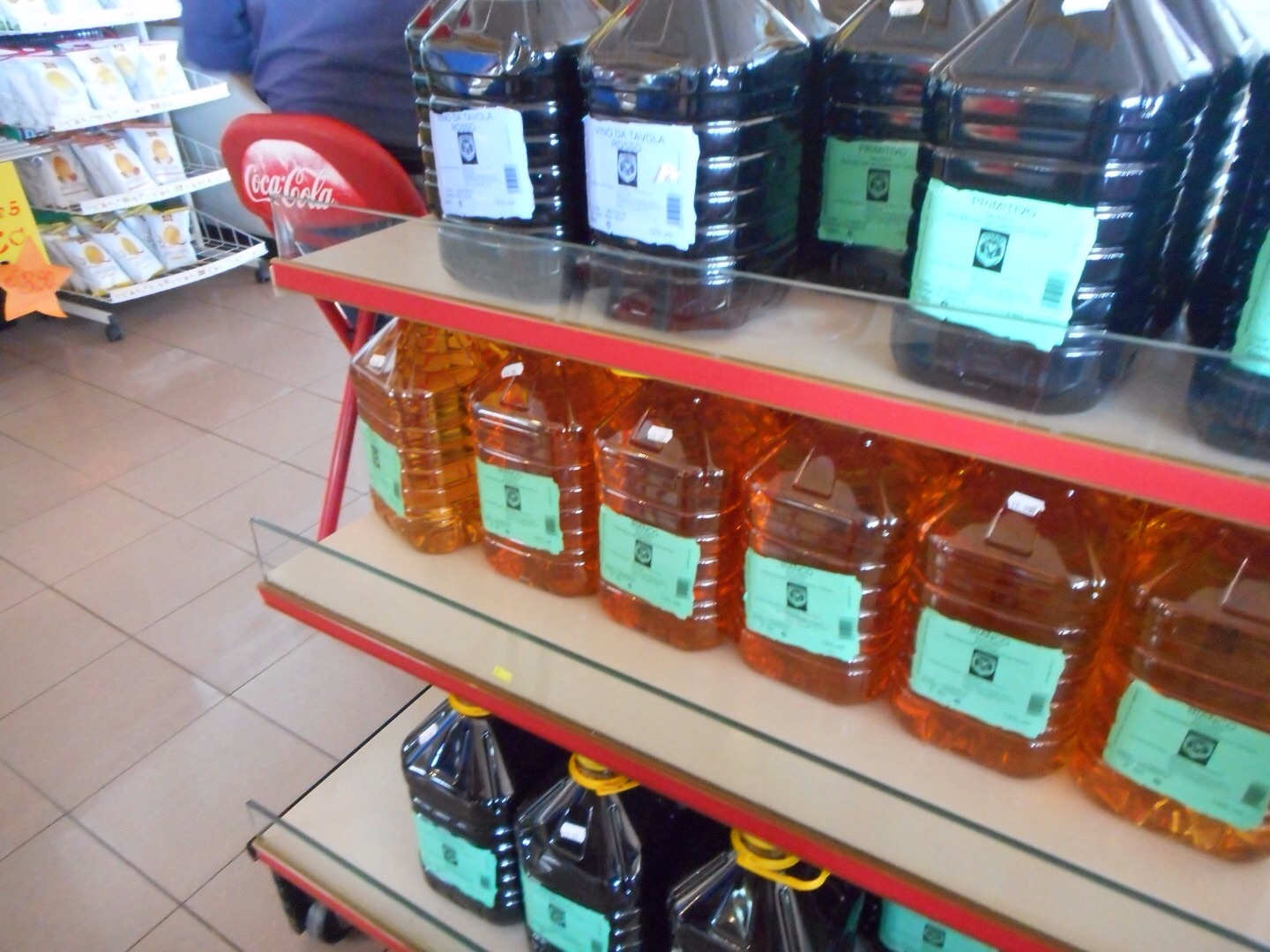
On the way home, I decided to stop for gas, and we found a gas station-coffee shop-snack bar-gambling parlor and bar – all rolled up into one.  A few men were off to the side, betting at the machines.  Two men were drinking beer, a couple of women had expresso at the bar.  We and another couple were having sandwiches.  Right beside us was a shelf selling 5 liters of wine for about $10.  I noted that one of the wines was labeled “rough”.  Obviously where the locals come.

image  image

Day 15: Verbicaro, Calabria

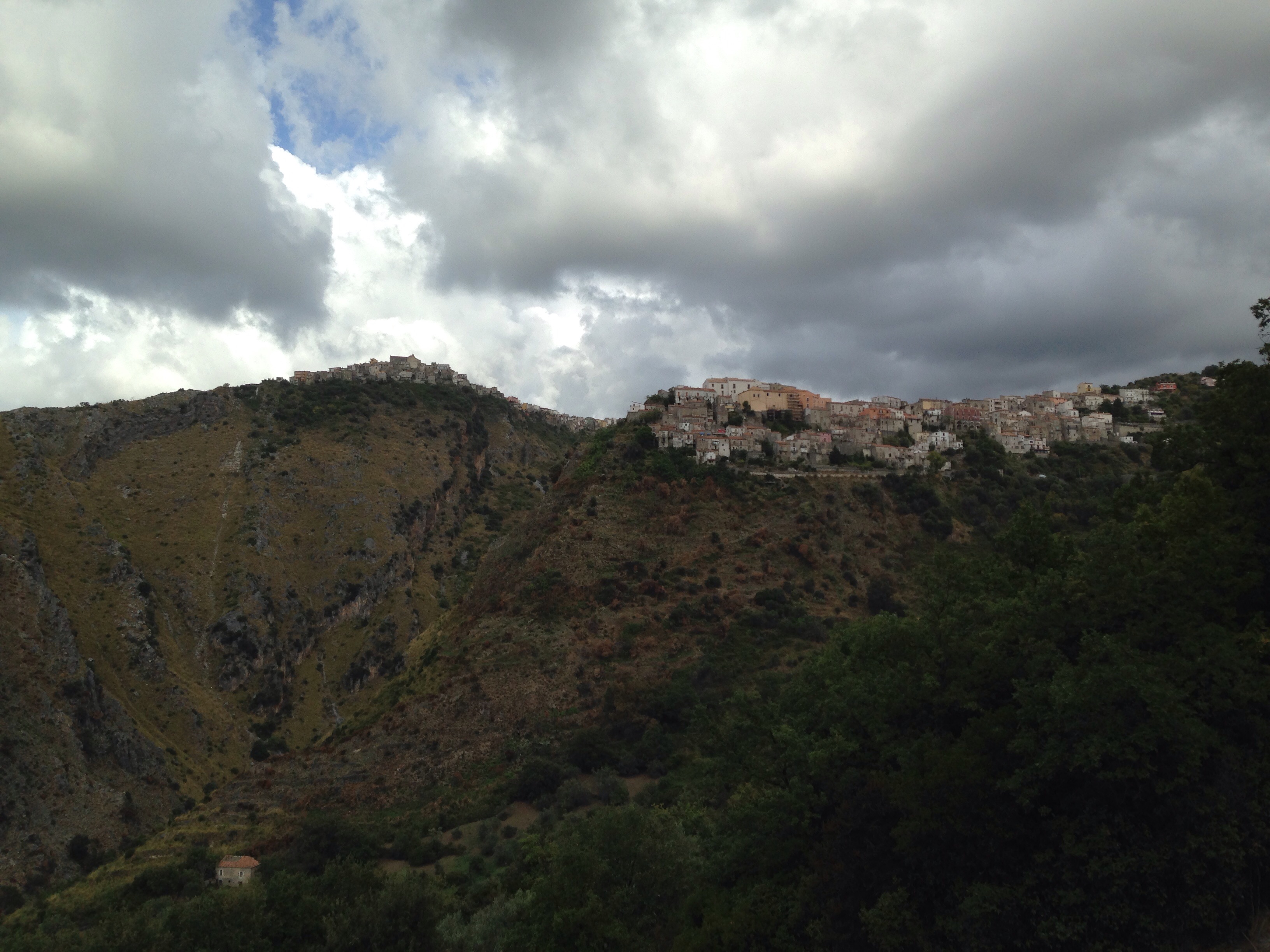
Tom’s grandparents on one side came from Italy;  his grandmother came from the small hilltop town of Verbicaro, which is why we were in this neck of the woods in the first place.  Having got a good night’s sleep, Tom got out the GPS and plotted a route back down our mountain and up the next.

image

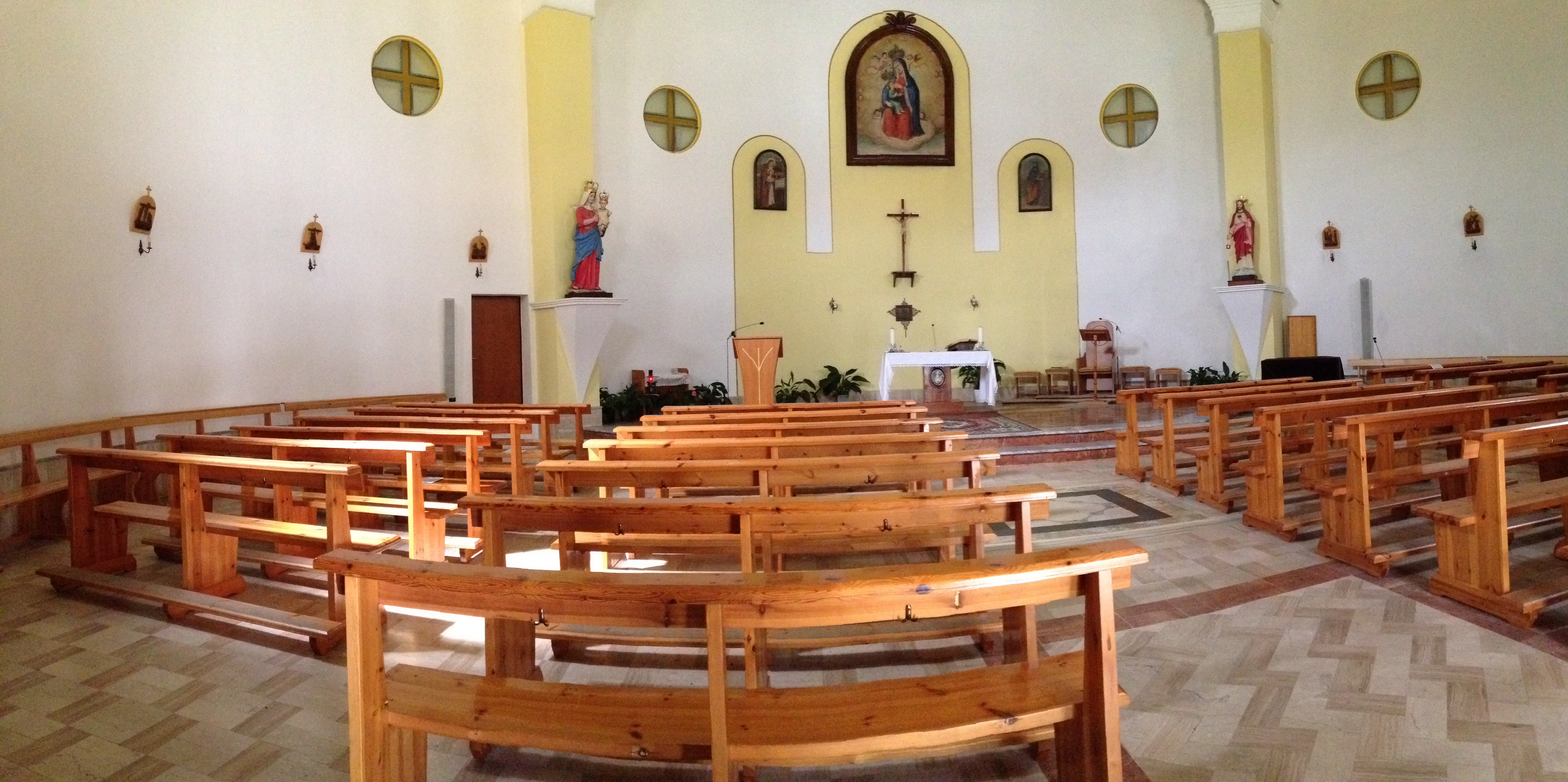
Approaching the town, it looked very lovely, but the outskirts weren’t attractive.  Lots of blocky apartment buildings with fading paint stood around like strangers with nothing to do.  Strangers who didn’t know each other, either, because there was no cohesion to it.  We found a church in that neighborhood and looked in.  The parish offices seemed to be in a building around the back, and we went back and rang both the doorbells, to no avail.  I was mentally practicing what I could say in Italian to explain our presence on the doorstep.

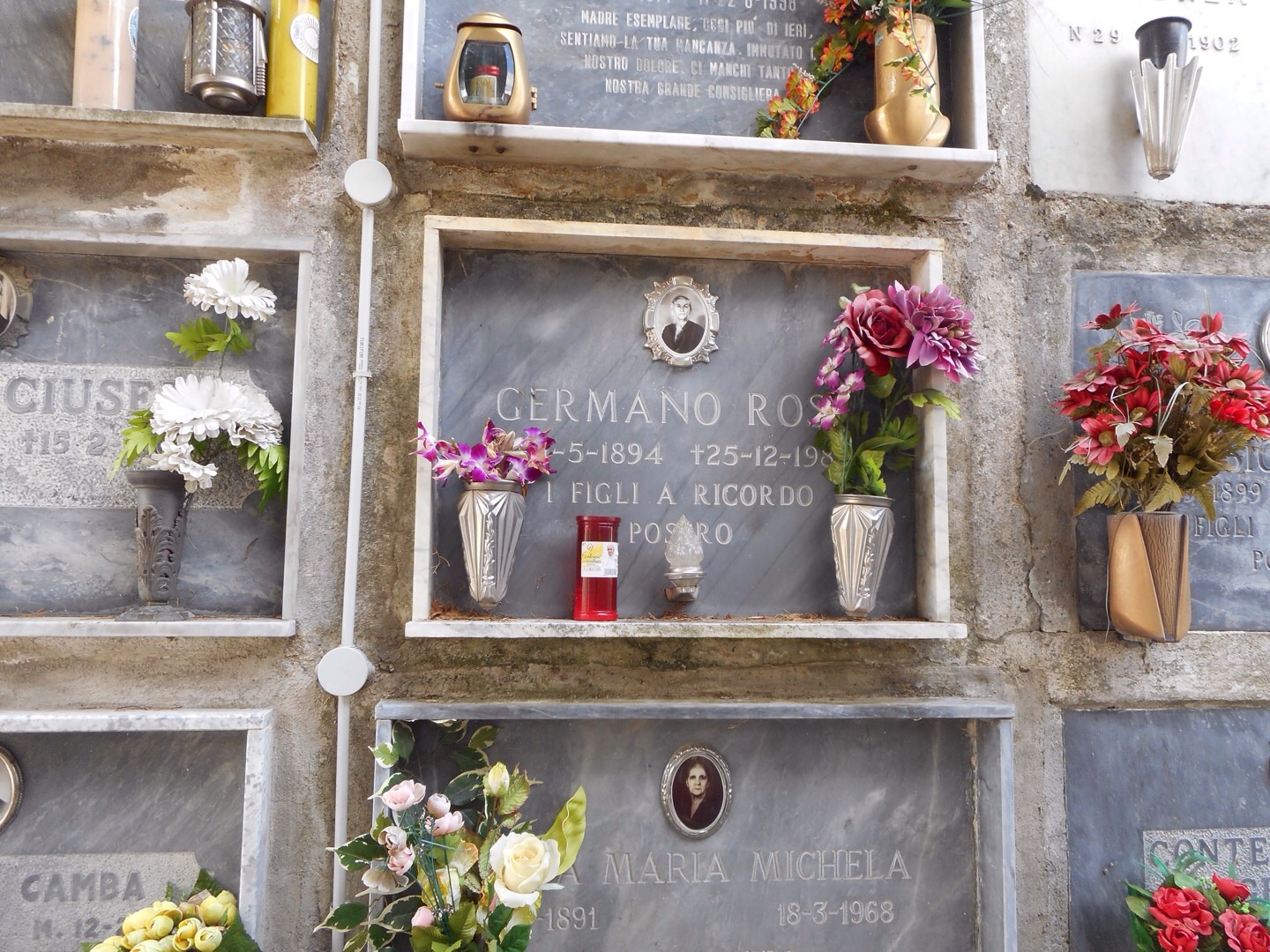
Having had no luck, we descended into the older part of town, looking for the town cemetery.  We thought we might find Tom’s great-grandparents, whose names we knew.  We got as far as a small piazza, but then could drive no further.  We asked directions, and found out I had the wrong pronounciation for “cemetery”, but finally got directions, and found the place outside town, down a badly-maintained slip road.

image

There was no sign with a phone number to call for information, so we went in and browsed, “Hi, anyone home?”  A small older center of the place held a grassy area with older, simple iron crosses.  Some had names, but they were either rusted away completely or so hard to read, it was hardly worthwhile.

image

All around, like the more affluent neighbors of the suburbs, stood family mauloleums, some very eleborate with standing areas inside and glass doors;  some with marble slabs announcing the name of the deceased within.  In some cases the tombs were so tightly packed together that you had to kind of slide sideways and crouch down to read the names.  We came across some familiar family names, but no hits.

image

I had picked up a Sunday bulletin in the church and once we got back to the hotel, I called the number.  Unfortunately, I got a recorded message which was so fast, I couldn’t understand a word.  I got hold of the number of the Diocese, and tried to call there, hoping there would be cemetery records which might help.  No answer at all.

Feeling a little let down by the whole thing, we decided to let it go until we could pursue family research from home.

We were beginning to be a little disappointed by the appearance of Italian houses and villages.  Maiera’ was apparently an exception, being well-kept and even decorated, with a sense of identity.  We noticed that houses we passed seemed to have no attention paid to their outside areas;  curbs were crumbling, weeds grew everywhere, paint was fading, peeling or non-existant.  There was a sameness to the styles that reminded us of the shapes of ancient Roman houses;  maybe all the decor and sense of comfort is inside?  The outsides were very uninviting, in any case.  It was late afternoon by this time, and we decided to call it a day.

Day 14: Calabria

We got to the hotel last night after a spine-tingling drive up hairpin curves after dark.  We were greeted at the hotel by oil lamps set on the ancient stone steps, like medieval travelers arriving at a hostelry.

The village is called Matiera’, founded by the Greeks at the time when southern Italy was a Greek colony.

Our room is a marvel of modernity, high ceilings, but not a lot of floor space.  The space problem has been solved by creating a very modern sleeping loft with a king-sized bed.  The bathroom is attractive and comfortable, and there’s the original balcony, its stone floor set securely into the wall with a stunning view of the plain below and the sea.

image

We hadn’t had dinner, and were starving, but I wasn’t up to driving around looking for food.  We were asked what we would like, and asked for bread, cheese and some meat.  There arrived a plate with a selection of cheeses, prociutto, bread and a plate of fresh fruit.

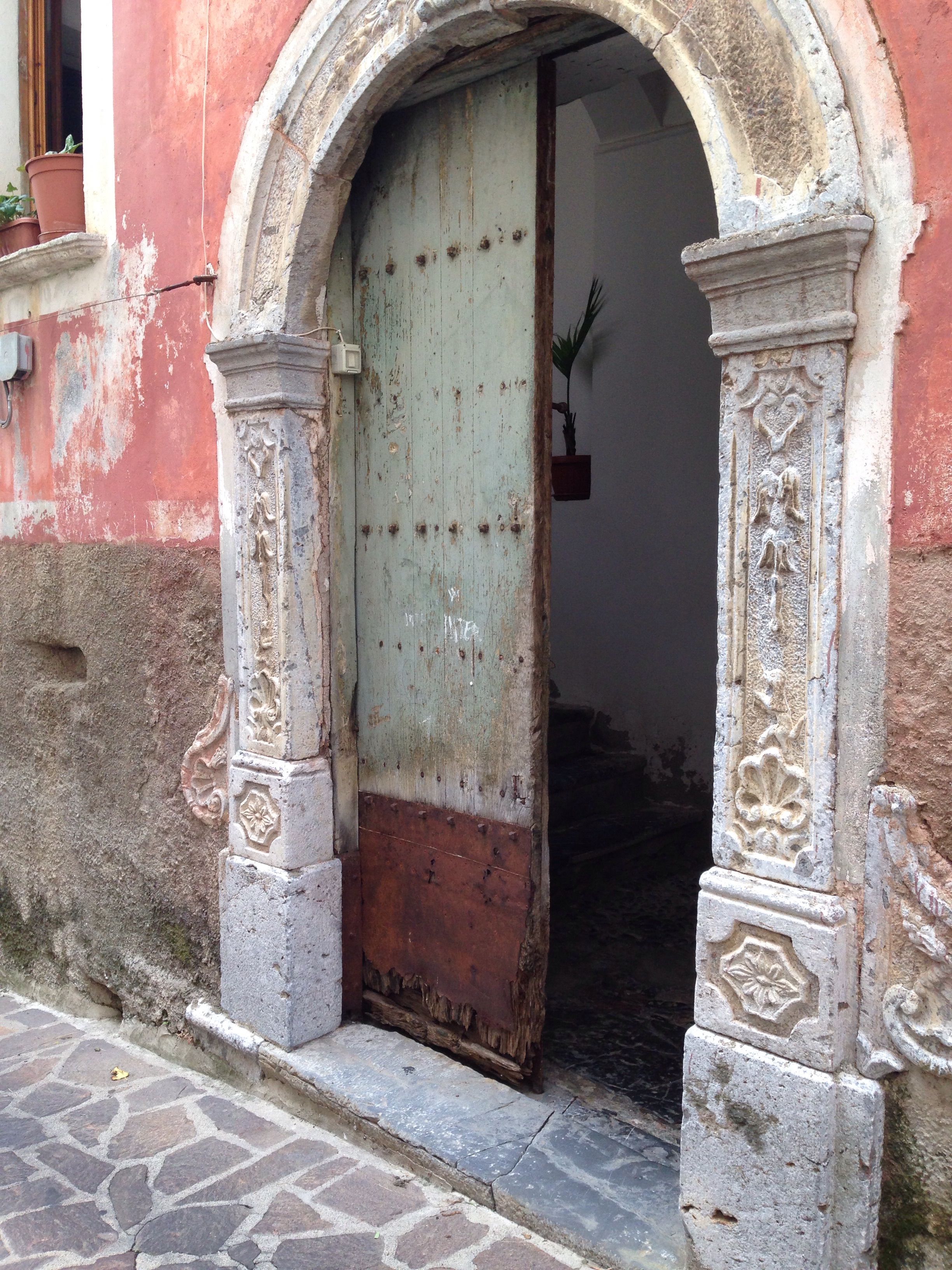
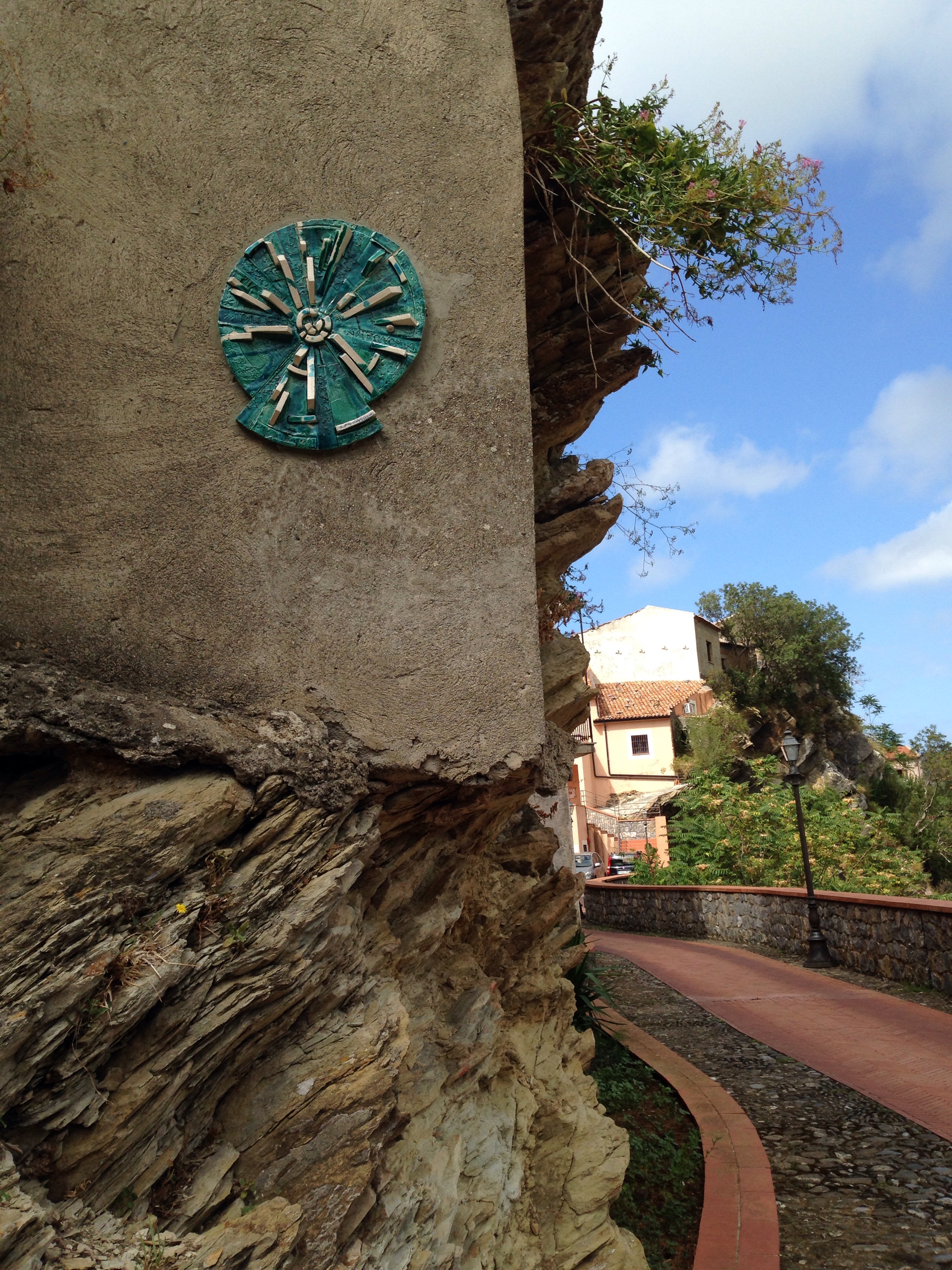
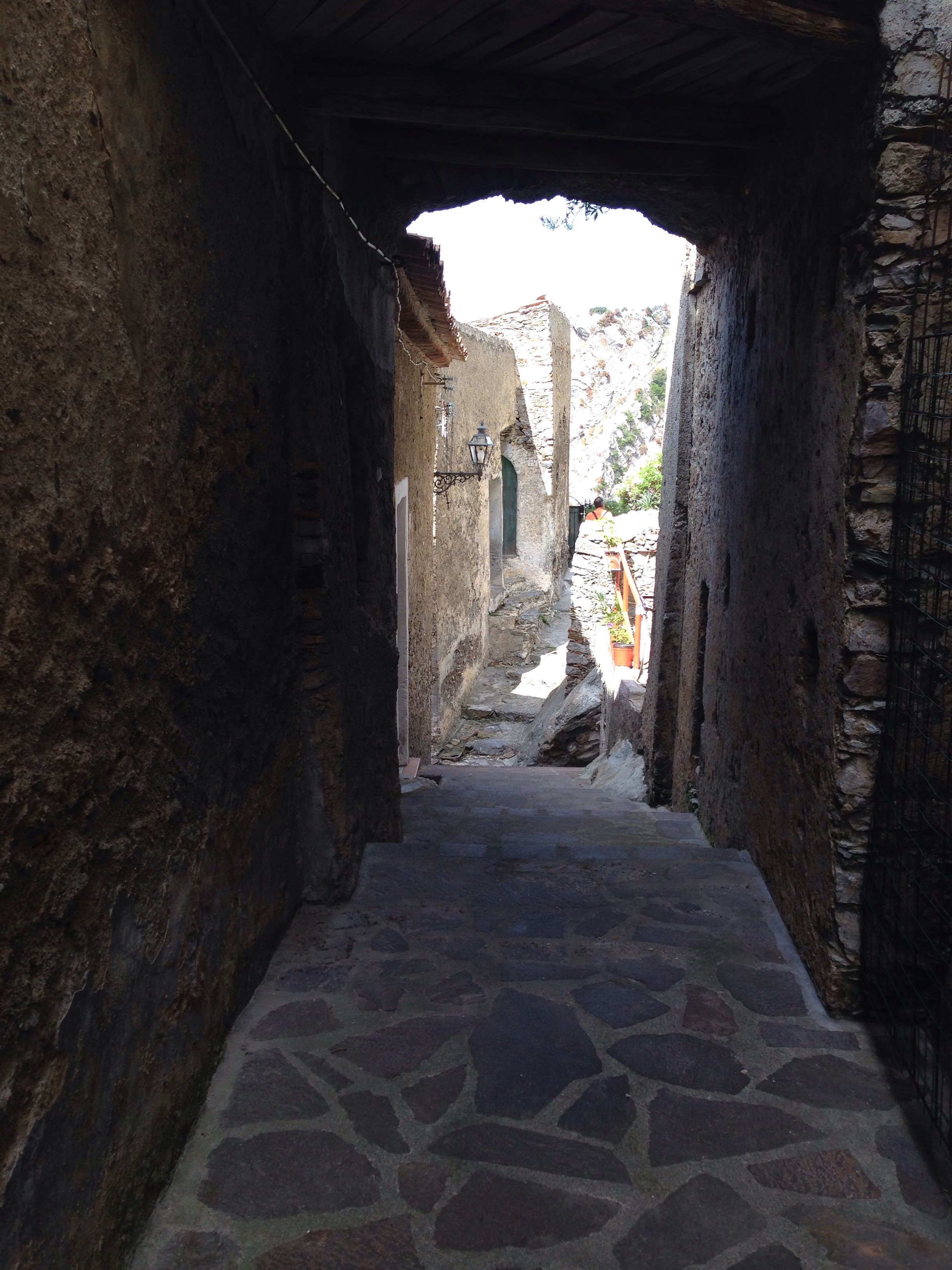
In the morning, we explored this ancient town, which has the flair of an artists’ colony.  The main road (a few residents with small cars drive it), and the pedestrian streets are all paved attractively with stone and tile.  Ceramics are imbedded along the walls of houses, which are well-kept.

image image image

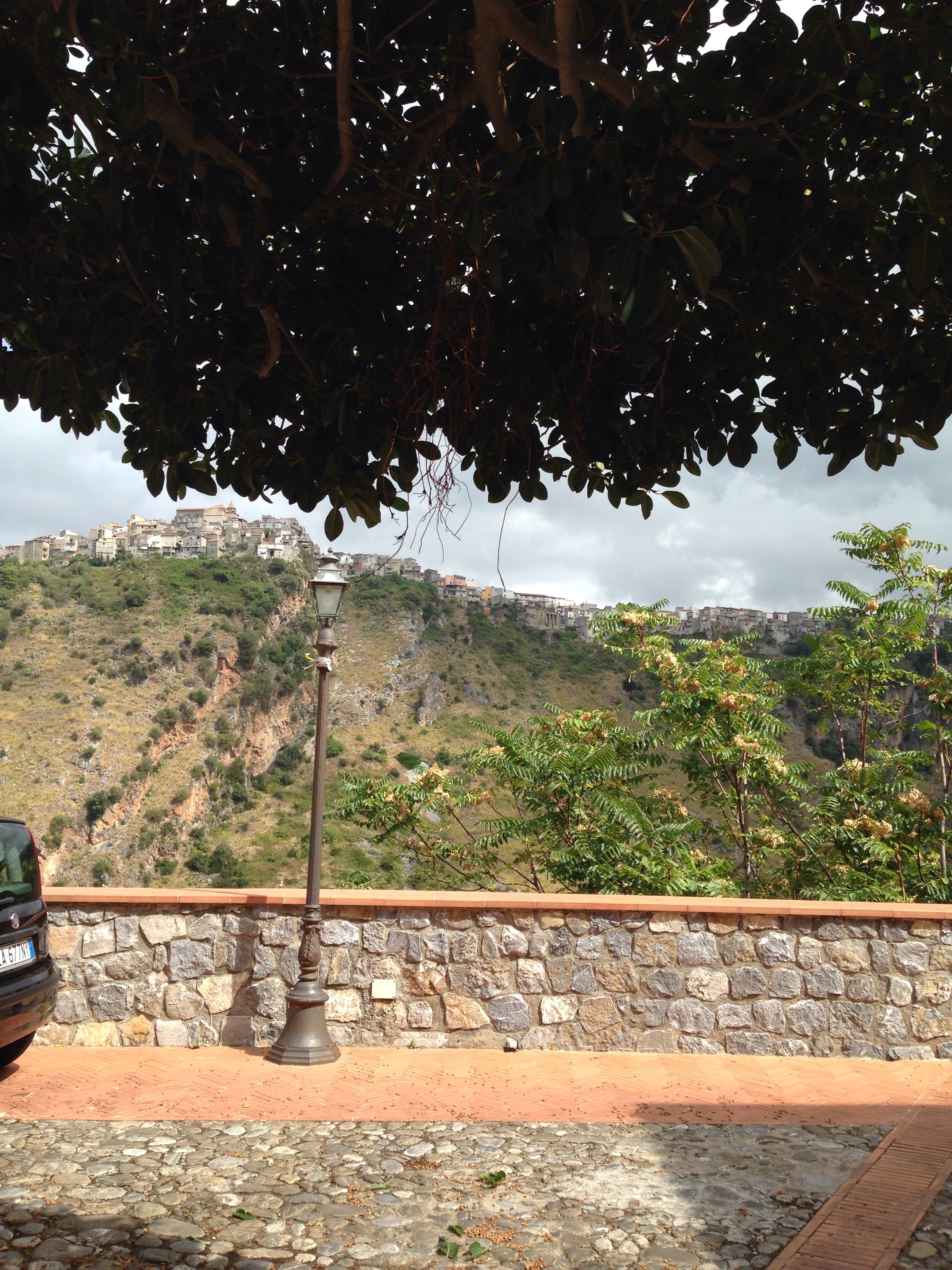
From the tiny piazza at one end of the town, where I sweated out my ten-point car turn of the night before, you can see the next hilltop town of Grisolia, separated from our mountain by a scary ravine.  At another side of the town, we discovered another view of the sea from someone’s patio.

image  image

Day 13: Arrivaderci, Napoli! On to Amalfi and Calabria

I promise I’ll catch up, but for now…

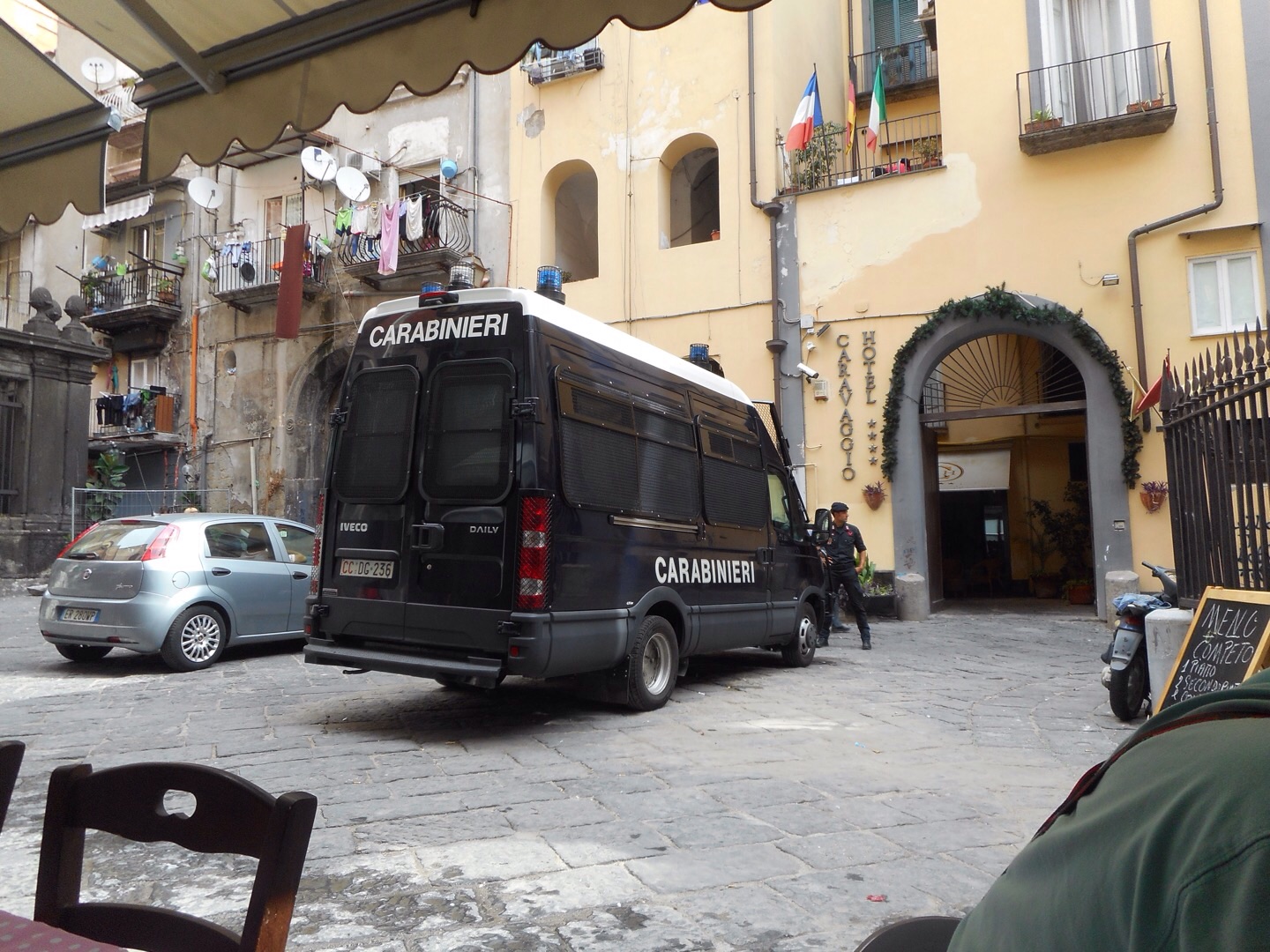
We left Naples by car, having rented one from Maggiore, an Italian rental-car company with an office conveniently at the Naples Garibaldi train station.  Thank God for GPS, which got us out of the city on the Feast Day of San Gennaro.  Already our Piazza was swarming with cababinieri, one of whom took pity on me when my phone wouldn’t work to call a cab, and who called them with his own cell phone.

image

The A3 autostrada is the main route south, before you take a right onto the Amalfi Coast, and it was a pleasant surprise.  Well-maintained, with frequent pull-in areas for emergencies, it felt safe and fast.  We sped off onto the exit for Amalfi, and came to a quick halt, because apparently the rest of the world was heading there, too.

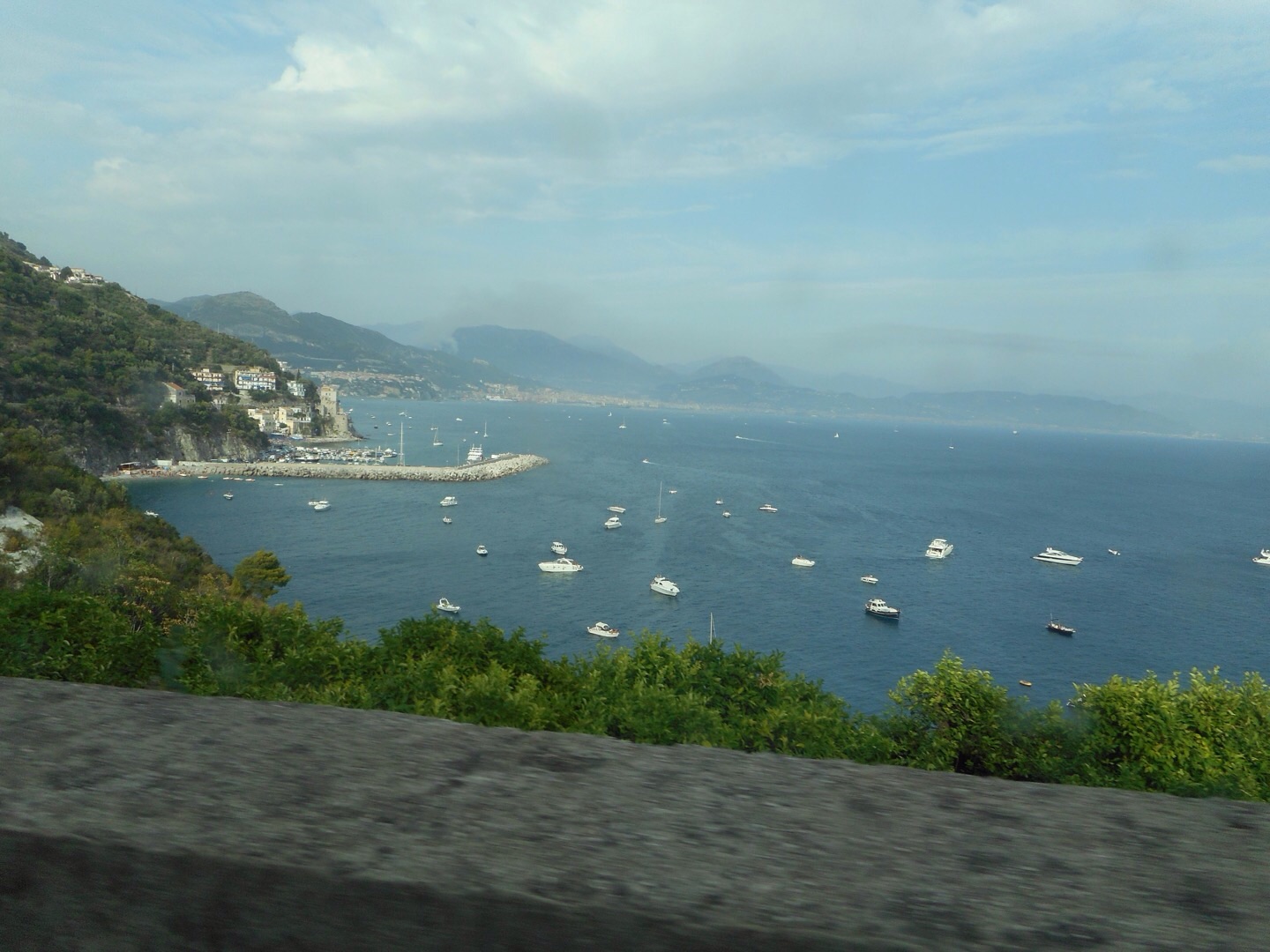
When we actually got onto the road, it wasn’t bad at all.  The coast is stunning;  sheer cliffs falling right into blue sea, postcard-like villages hugging the hills above the water, and always the ever-changing perspective as you round narrow turns.

Luckily, almost everyone is taking their time, except the many motorcycles, but I learned to keep an eye out for them, and just keep driving predictably, so that they could weave past me safely.

image  image

I was a little confused by the fact that the sea was on my left (didn’t I want to head east???), but Tom was navigating, so I pushed the thought aside.  We were hoping to stop for lunch in Amalfi, but it was so jammed with tourists, that we just drove through.  A few miles further, Tom came to the conclusion that we were headed the wrong way (how did that happen?), and I found a place to reverse, and turned back.

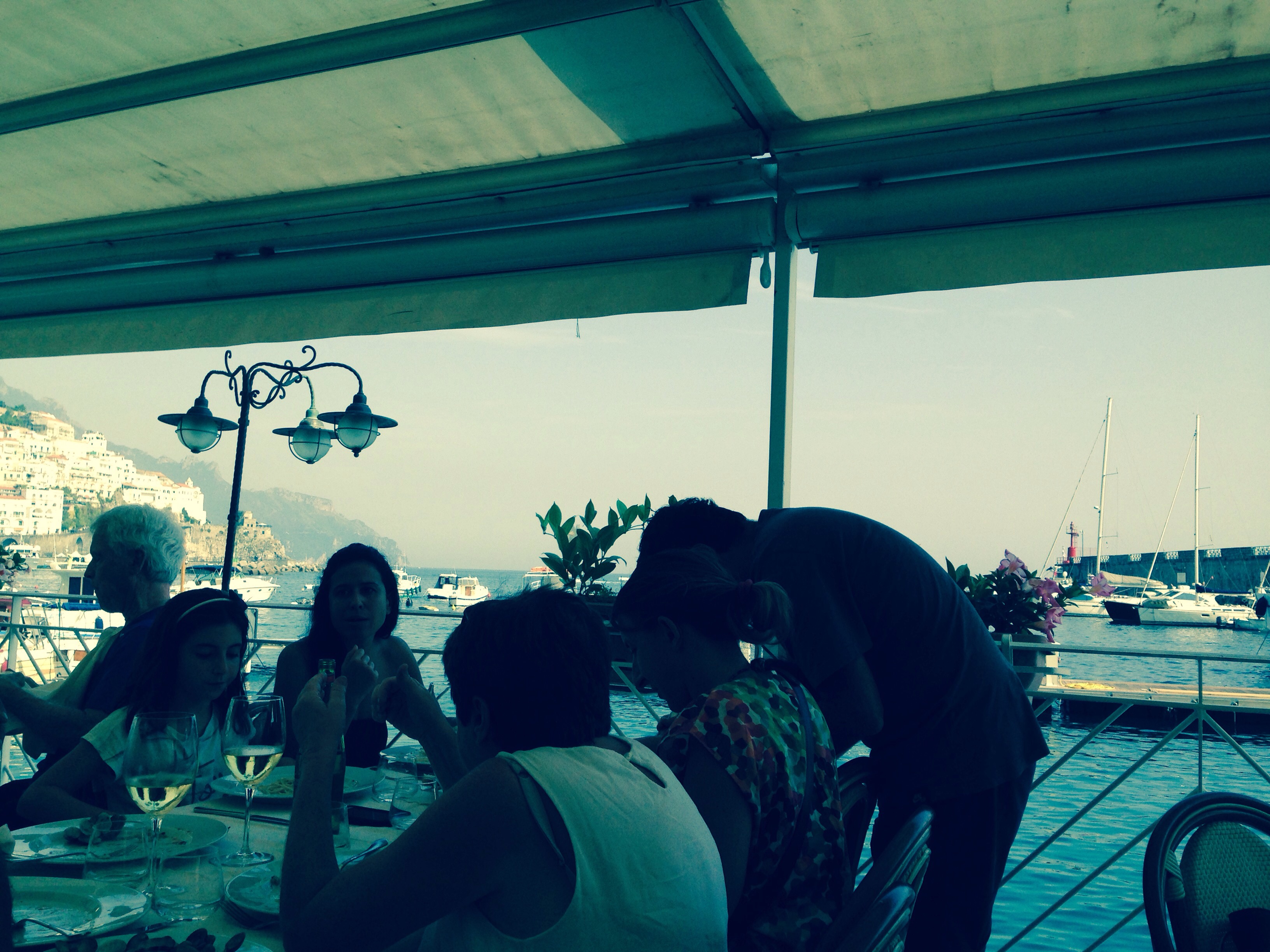
This time when we got to Amalfi, I wanted to stop.  My opportunities to see anything had to coincide with the twists in the road, and it was frustrating not to be able to stop and gawk, so we found a place to park and went into a nice restaurant down on the water.  Unfortunately, when we came out, we discovered that our nice, convenient parking stop was in a no-parking zone.  The owner of the pay-parking across the street had called the police in a huff, then lied (in Italian, figuring I wouldn’t understand) to another unfortunate couple that Tom had cursed at him, refused to move, and made a rude hand gesture.  There had, in fact, been no interaction between us at all.

Watch where you park.

Eventually someone showed up to let us ransom our car, for 140 euro, and we headed in the correct direction.

image  At least lunch was good!

I got back onto the autostrada, and drove south into more and more mountainous terrain.  The engineers building the road had opted to build tunnel after tunnel, keeping the road nice and straight, and it was a little like diving into hobbit-holes, as you drove into round openings in grassy hills, one after the other.

We had made a hotel reservation in the small town of Maiera’, a hill town near the sea in the province of Cosenza, Calabria, and were trying to get there before dark.  As we came further south, the hills of Naples gave way to serious mountains, reminding me of the Rockies in their harsh outlines, though not nearly as high.  The valleys and ravines between mountains are dramatic, and bridges link one mountain to the next, so that you look down at precipices as you pass.   The road became twisty, mist was coming up between the hills, and it was getting darker.  To our right lay a darkening sea.

GPS on my phone was useless, T-Mobile’s promise of data having evaporated somehow, so we were relying on Tom’s dedicated GPS.  By the time we got to the final turnoff, it was full dark.  The road was very, very twisty,  climbing sharply, and since it was dark, my headlights only illuminated a few meters of road at a time.  We seemed to climb for a long time, then found ourselves in a tiny village, following the sign for the Hotel Palazzo Bruni, which sounded a bit Buckingham Palace-like.
In the town there was a small parking lot with 5 or 6 cars already filling it, then an open gate that led beyond into the narrow heart of a very ancient village.  “Go on”, urged Tom. “I don’t think I’m supposed to drive there,” I said.  “Go on a little, at least,” said Tom, who wanted to lug suitcases as little as possible, and I did.  In my defense, I was tired.  I got about 40 feet down the “street” (which was paved with flagstones – another clue), and realized that I was all but stuck and would have to reverse back, uphill and around a curve.  Tom suggested we leave the car for the moment, find the hotel, and ask them what to do.
image

At this point, a bare-chested villager appeared, waved to me, and told me in fast Italian that I couldn’t park there.  I stumbled around in Italian, told him I was stuck, nervous about backing up, and didn’t know what to do.  At this moment, a woman appeared carrying a bag of shopping, and protested loudly that I couldn’t park there.  The man explained the problem, and she suddenly laughed, waved and disappeared.  Two old people popped out at the side of the street, and watched my confusion silently.  Suddenly, a young man appeared from the street in front, said he was from the hotel, and if I was very, very careful, there was a small piazza ahead where I could turn around.  He directed me from in front, and with my side mirrors folded in, I crawled down the street, sometimes with as little as an inch or two on either side.

The village is literally cut into the rock, and in one area, rock jutted out into the street and was tricky to get around.  The Amalfi Coast drive was a piece of cake, I decided.  We’ve been shown to a surprisingly modern room with a small balcony, which I’m guessing will give us a fabulous view in the morning.  We’ll see.  No one here seems to speak a word of English, so it will be fun to see how useable my rudimentary Italian is.

Day 10: Naples Day 4 – Pompeii

You would think we would have made the connection between cruise ships and the crowds on Capri, but we didn’t.  So, still clueless, we headed out to Pompeii on the Circumvesuviana Rail Line.  You can get this train from the main “Garibaldi” station in the heart of the city.  It was walking distance for us, although I have to admit we wimped out and took a cab.

This is a suburban commuter train with several lines, cheap and un-airconditioned, that connects among other places, Sorrento with Naples.  Along this line you can get off at Herculaneum (Ercolano) and Pompeii (Pompei).  The trip costs 2.60 euro each way, a bargain, and takes about 35 minutes.  You get out at the stop Pompei, Villa dei  Misteri. Then you wander about in a state of confusion for a few minutes, while hawkers size you up, figure out your native language, and yell at you in your language that there are tours in (insert language here).

On the train, it was hot and crowded, and we were treated to the sight of very run-down apartment blocks and abandoned buildings, covered often with graffiti at the beginning of the trip.  Gradually the buildings became cleaner and more comfortable-looking, and the Bay of Naples appeared in the near distance.  A group of Roma (I think) got onto the train with a boom box, and kept time to the very loud music with tambourines and bongos.  It was deafening, and the Italians rolled their eyes as a man moved down the aisle holding a plastic cup and asking for money.  The tourists avoided looking at him and held onto their bags, unnecessarily, I thought.  I rocked back and forth, trying to catch the breeze from the half-opened windows.

When we arrived and walked the short distance to the entrance, we found a very long line already in place.  Our friends were disgusted, and said there was no way they were waiting that long in the heat, but Tom and I really wanted to see the excavations, so we queued up, and immediately discovered that we were moving quickly.  As well as that, you could hide under the adjacent hedge and escape the worst of the heat.  I hid.

Admission is 13 euro, free for EU citizens under 25.  We got an official map, bought a guide book and set out.

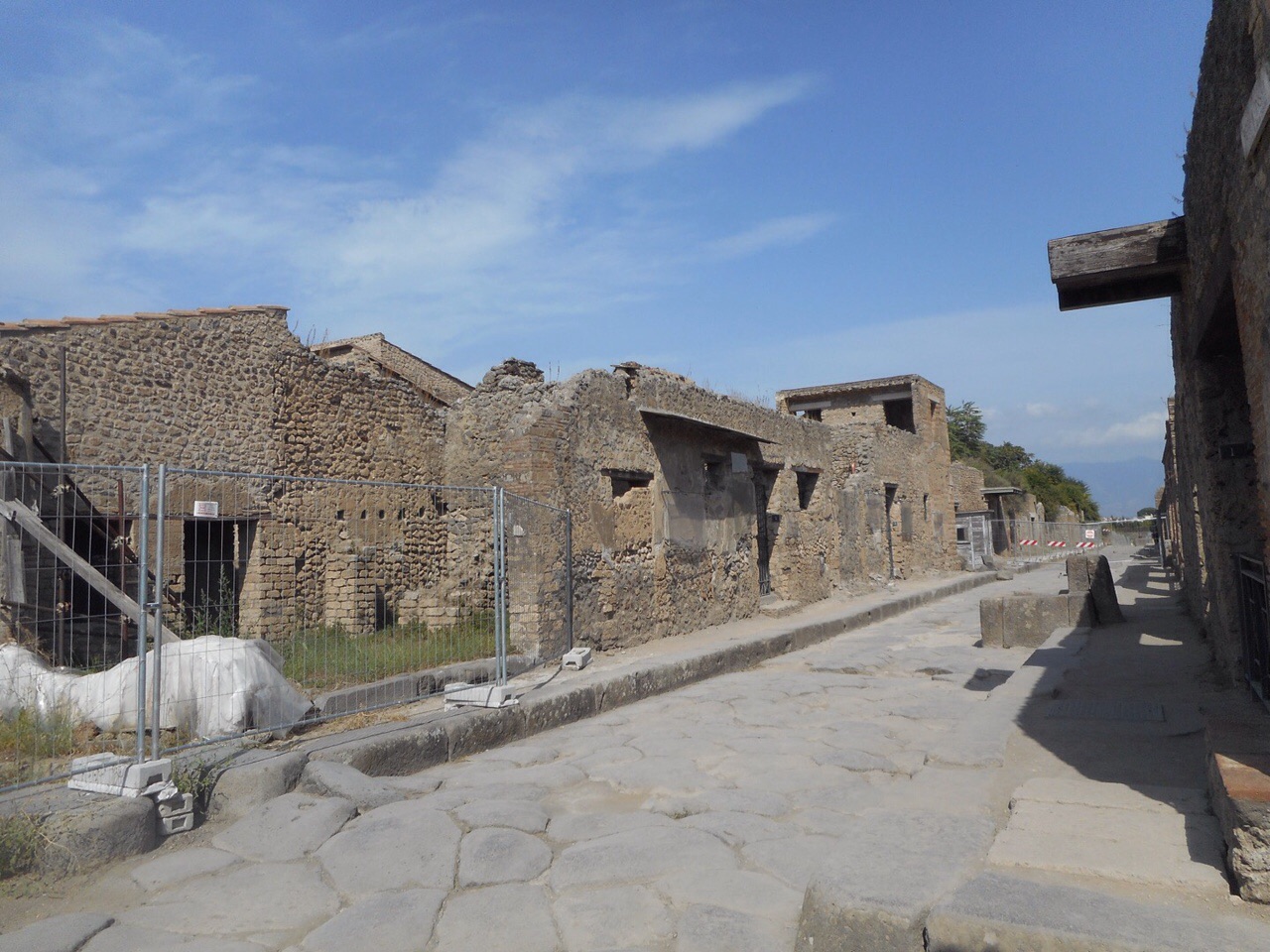
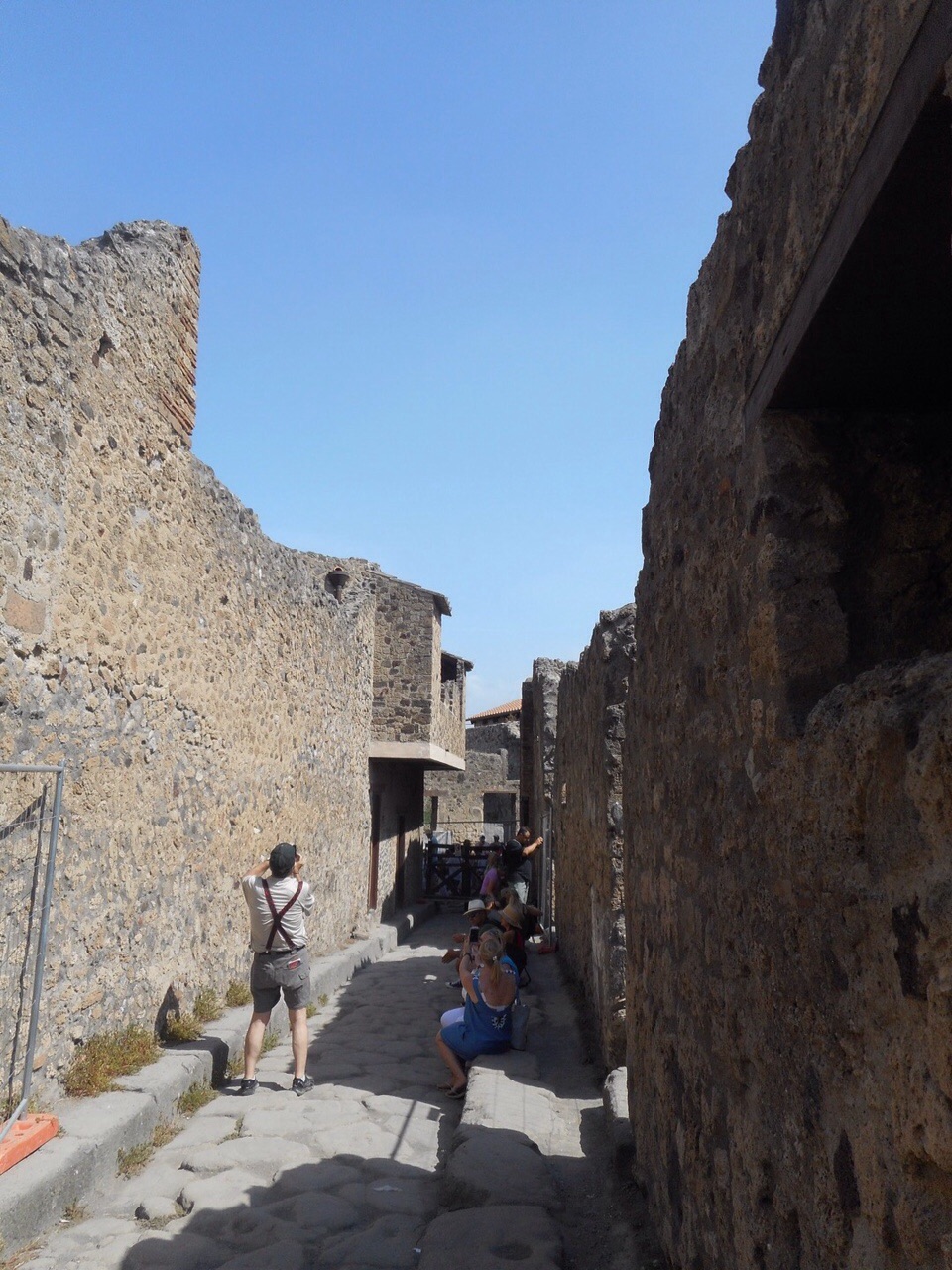
You have to watch your step on the ancient stones of the street, which also has a sidewalk on both sides, here and there with modern repairs.  Pedestrians could use stepping stones set at intervals, to cross the street during flooding, or to avoid dirt and manure from animals.  In many places, the ruts left by centuries of carts are still visible.  (The pattern of the street paving stones is similar in Italian cities today – stones are placed at angles, which makes it safer for wheels to avoid getting stuck in parallel ruts.  I saw this in Florence in the old city as well.)

image

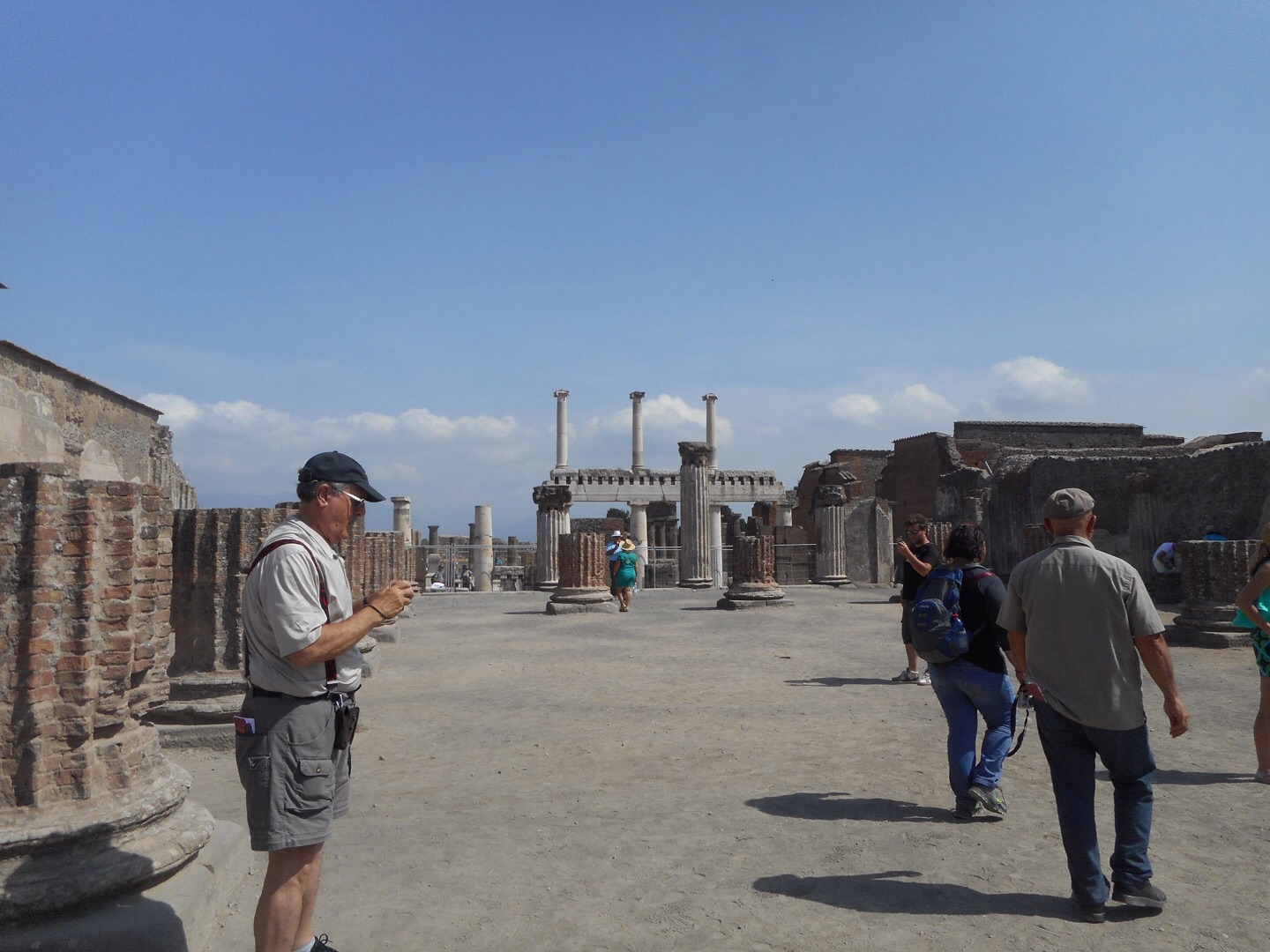
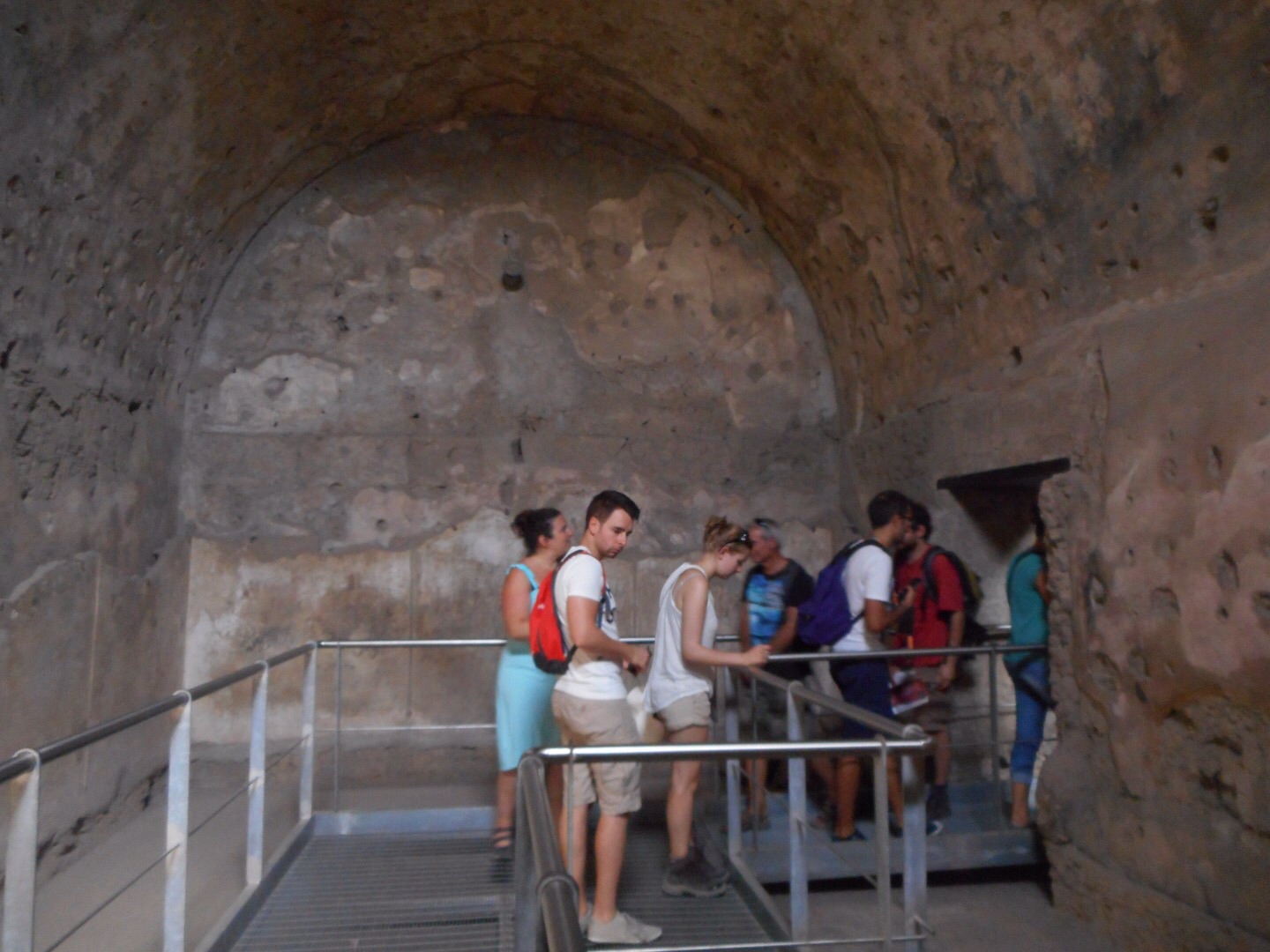
We walked down the main street, which led to the Forum, a huge space.  The size of it surprised me at first, until I considered that this was really the political and business center of the city, and its size indicated its importance.  Some of the original marble paving was still intact, in other places simpler stone paving.  We found one of the biggest complexes of baths, with separate areas for men and women.  The ceilings were intact here, and considerable remains of beautifully delicate carvings and wall paintings.

image     The Forum

image    image

The Baths

Outside was the remains of a swimming pool, originally a meter and a half deep.

There was a remains of a restaurant/snack bar, with the serving counter inset with terracotta pots for the food.  An area in the back would have offered a seating area for customers, and the owner and his family would probably have lived upstairs.  I imagined the seating area, which was not roofed, covered with an arbor of vines for shade.

It was hard to figure out what was what.  One map had numbers of buildings up to 45, and we found buildings with numbers into the 60’s.  Then we found the same number again on a different building.  We gradually realized that the city, for modern interpretation, is divided into sections.  I have no idea if this corresponds to an original way of figuring addresses.  We were both confused, and wondered if we should have got a tour.

There were crowds everywhere.  Masses of people were trotting along behind guides with umbrellas or other long items held aloft for identification.  I hate the idea of tours.  We tried to get to see the brothel, obviously a highlight for tours, but the lines were too long and we were too hot.  The reality of the cruise ships started to dawn on us.

image   image

Amphitheater                                           Great Palestra

We did see the larger amphitheater.  Unfortunately, a rather ugly plywood pyramid had been built smack in the middle, with an exhibition of art inspired by Pompeii, but its placement made it impossible to get a good all-round view of the theater.  Behind it was the Palestra, the Roman equivalent of organized youth sports, where young men got exercise, learned sports, and were taught to value Roman and Imperial ideals.

image     The necropolis

We found the necropolis at the edge of the city, and tried to discipher the inscriptions with our high school Latin, with limited success.  I was amazed I could figure out anything, and thought nice things about my Latin teacher.

image  image

The crowds were thinning out, so we could finally get some good photos of the streets of the city, much more evocative without crowds of modern tourists.  I had got to the end of my tether, and Tom wasn’t looking too good either.  We followed the exiting masses and got some cold drinks before climbing back onto the Circumvesuviana, and heading home to our apartment.

Day 9: Naples Day 3 – Capri

One of the two sights on our must-see list was the island of Capri, and on Capri, the Blue Grotto.  I knew that waiting times to get into the grotto were normally long, but it being mid-September, we decided that an hour’s wait or so wasn’t unbearable.  The four of us took a taxi to the waterfront, and carefully crossed the aptly-named Via Action to Molo Beverello, Molo Docks, where the high-speed ferries leave for Capri and Ischia.  Tickets are about 20 euro each way (the price varies slightly according to when you go), and we finally boarded with several hundred of our closest friends.  The harbor had a number of huge cruise ships, whose significance we missed completely.

I had thought we would sit outside, but all seats were airplane-like armchairs inside.  Why that is so became apparent when we set off.  Naples is a huge port, and many boats create many wakes behind them.  The ride was rough.  We pitched, rose and fell sharply, and the staff began walking around handing out plastic bags for the tourists who were about to part company with their breakfasts.  Unfortunately, Rob was one of those who felt sick, and had to retreat to a small area in the fresh air, where a number of passengers were being helped.

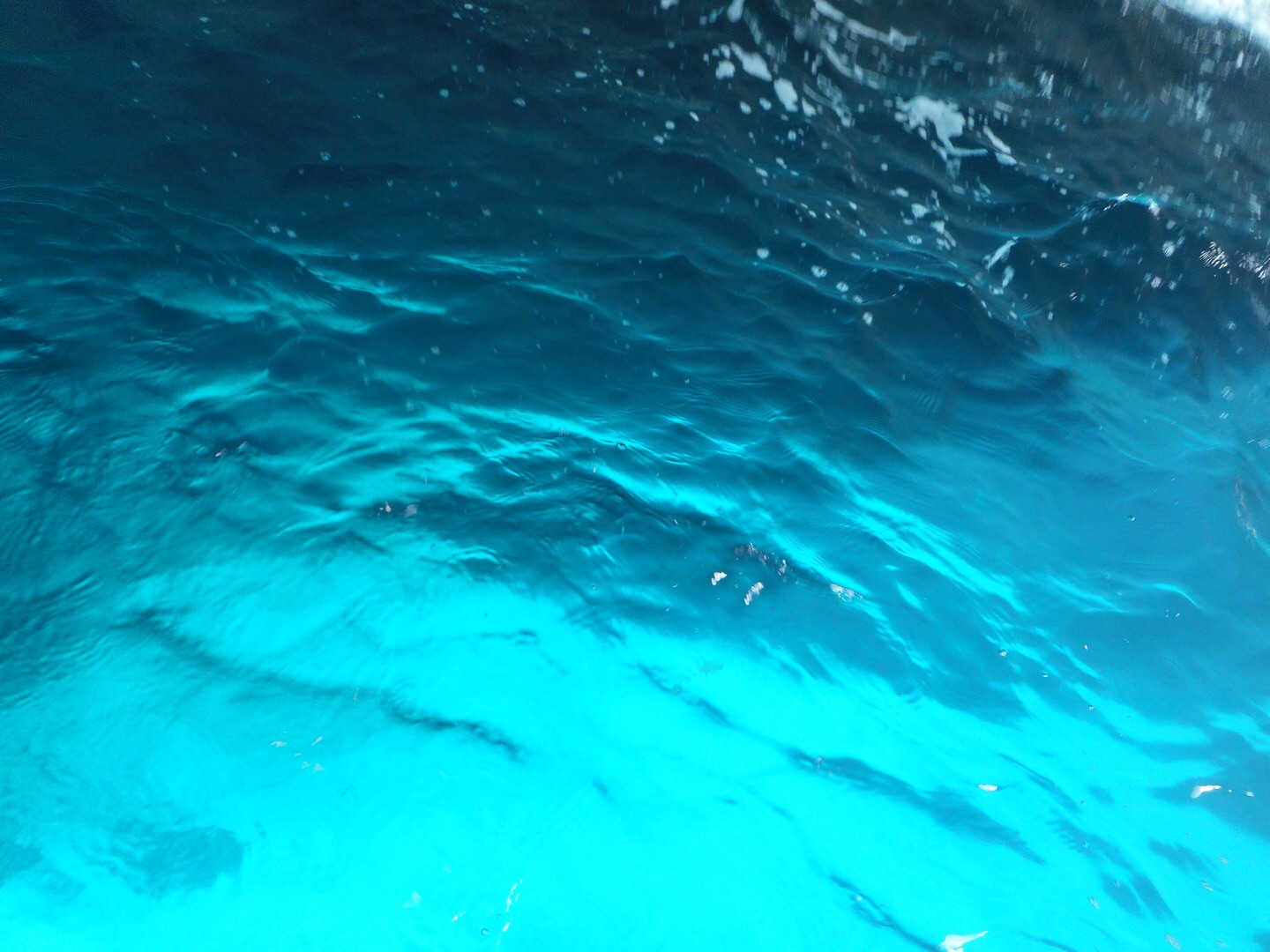
When we got off the boat, and checked that our friends would be alright, Tom and I raced for a boat leaving just that moment for a tour around the island and the Blue Grotto.  It’s a wonderful tour;  the pilot brought us close to the cliffs and the caves that line the coastline.  One cave, now about 30 feet above sea level, had yielded a lot of archaeological finds, going back 40,000 years, the pilot told us.  We chugged into the entrance of two of the caves as far as we could go, to see the sea water change to a glowing greeny-blue.  The pilot told us it was just the same as the Blue Grotto, and why would anyone want to wait the three hours in line that we would have to do today?

image  image

The cliffs were very high, the sun hot and the sea very blue.  Spray washed over me time and again, cooling me off.  Passengers lurched from one side to the other for their best photo ops.

image

When we finally arrived at the Blue Grotto, it was clear that the wait was impossible.  At least 10 large boats, loaded with at least 20-25 people each, were moored off the coast, waiting for their turn to disgorge people into the small rowboats that would take you for a very few minutes into the grotto.  Everyone voted against waiting, so we set off again.  I have to admit to disappointment – I’d been waiting years to see it, but what we did see was so beautiful, and the rest of the ride was so much fun, I figured I probably didn’t miss much, all told.

When we got back to shore, the crowds of tourists were overwhelming.  The cruise ship excursions in Naples necessarily include Capri and Pompeii, and most of them were on Capri that day.  It was hot on land, but it seemed that we should at least try to see something more of the island, so we secured return tickets to Naples on the next ferry, and bought tickets to the funicular that runs from the harbor up the small mountain to Capri town.

image     image image

The main piazza is a mini-piazza, and the streets leading off it are full of shopping, which didn’t interest us.  We admired the view of the harbor, and explored some of the side residential streets, which are lovely.  A few minutes of this, though, and the heat had got to us.  We decided to get down the hill and get a drink.

As the funicular descended, I could see more clearly than on the way up that the hillside was terraced into lemon groves and grape-growing mini-fields.  The lemons suddenly reminded me that I had yet to try lemoncello, the lemon liquor that some say comes from Capri (others say the Amalfi Coast).  We sat down at the edge of the harbor sidewalk, drank lemoncello and cokes, and finally boarded the ferry back to Naples.

image

Days 7 & 8: Naples, Days 1 & 2

At 6:20 a.m., we left the apartment, and hauled our cases down the street about 3 blocks to the train station.  We had reserved seats for the 5 1/2 hour trip to Naples, and were glad we did.

We had reserved our seats months in advance, and got our seats for 9 euro each (about $11), an incredible bargain.  In general, train travel in Italy is very cheap, especially if you can plan ahead.  Another bonus:  having reserved online, all you need to show the conductor is a copy of your email confirmation from Trenitalia, the Italian Rail Service, showing your booking number.  No standing in line or thumping the ticket machine.

We also learned how to use the coffee machine on the train platform, which I foresee being useful.

My rudimentary Italian has proven useful on this trip, and it proved so again when we got to Naples.  The cab driver didn’t know exactly where our address was until I sputtered something about it being “next to the Duomo” and having a “Monumento” in it.  Having arrived, we were faced with a huge, intimidating door with a small people door cut into it, locked tight.  I had been told that someone would be there to let us in, but how to find her?  Rob tried calling her number, I tried, and all we got was a message telling us in two languages that “this number has not yet been assigned”.  Click.

I channeled my inner Neapolitan, and yelled up at the lower balcony.  A head appeared, and someone said, “Angela?”  “Si”, I yelled, and a few minutes later, Giovanna let us in.  Our apartment is a bit quirky, but very nice.  We have three bedrooms (one single, which we don’t need), and two bathrooms.  We have wifi, and a nice TV with lots of stations, one even in English.  The only problem is the curved archway which isn’t high enough to walk through at the side.  The men have found this out through experience.

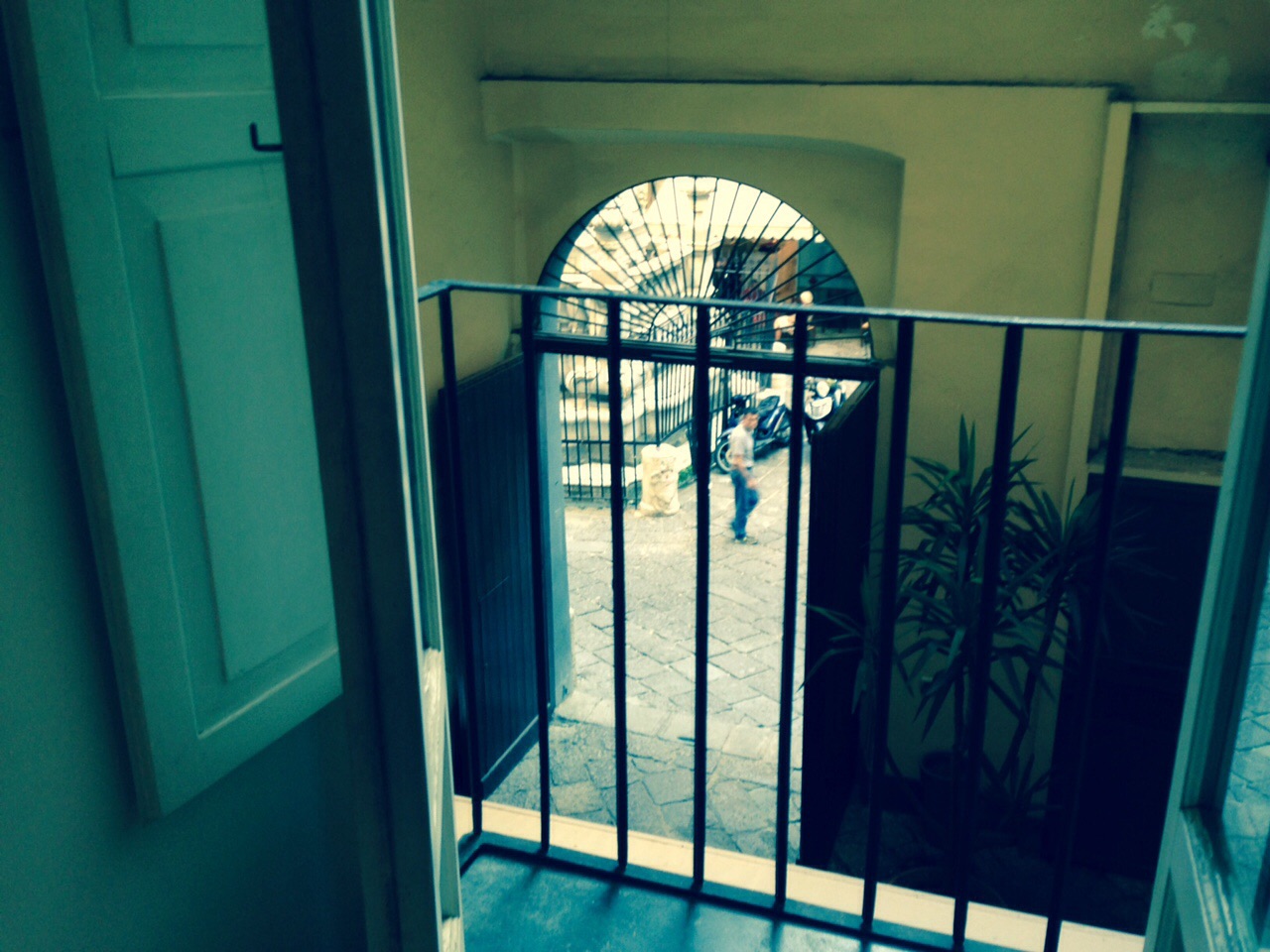
We have two balconies which look out, not onto the street, as you would think, but onto a courtyard which serves as the entrance for a hotel, and another balcony directly on the piazza.  Cardinal Sforza has a huge monument to himself in the piazza, which rather cuts off our view, and takes up about a quarter of the entire piazza.  It’s all situated on an ancient street called Via dei Tribunali, which was one of the three central Roman streets crossing the city in parallel in Imperial times, from east to west.  As such, most of the oldest buildings and archaealogy finds are  located here.

image image

The old city is gritty and run-down, smelly and has an edgy, slightly dangerous feel.  I like it.  Everybody yells.  Apparently I was behaving absolutely in line with everybody else by screaming in the street.  Smaller streets branch off the Via dei Tribunali north and south, approximately, and they are densely populated with immigrants, and I would say it approximates the Lower East Side of New York at the turn of the 20th century.  You look into apartments as you pass, and there’s a table, one light, the door open and people sweating over dinner.

image

The people are intense, good-looking and dark.  They crowd the streets, cars zip down our street one way; there’s no sidewalk, only cobbles, and barely room to step around people out of the traffic.  Motorcycles roar up and down the streets at all hours, and the Duomo sets up a racket of booming bells, right into the bedroom, at six every evening, and in the mornings on Sunday.  Laundry hangs from balconies, and I can attest to the fact that this is practical.  It’s right there for you, and dries fast. Why  not?

Audrey and I had been chomping at the bit to do our own laundry, and there was a washing machine in the apartment.  Unfortunately it came with rudimentary and confusing directions – in Italian, of course – and it didn’t take us long to run into one snag that almost had us stumped.  It appeared that once the cycle was over, you couldn’t open the door to liberate the dripping contents without getting the procedure correct.  Click a certain knob, walk away for about fifteen minutes, then come back and open the door.  We found this out, after I got the door open prematurely and got water all over the bathroom floor.  Durp.

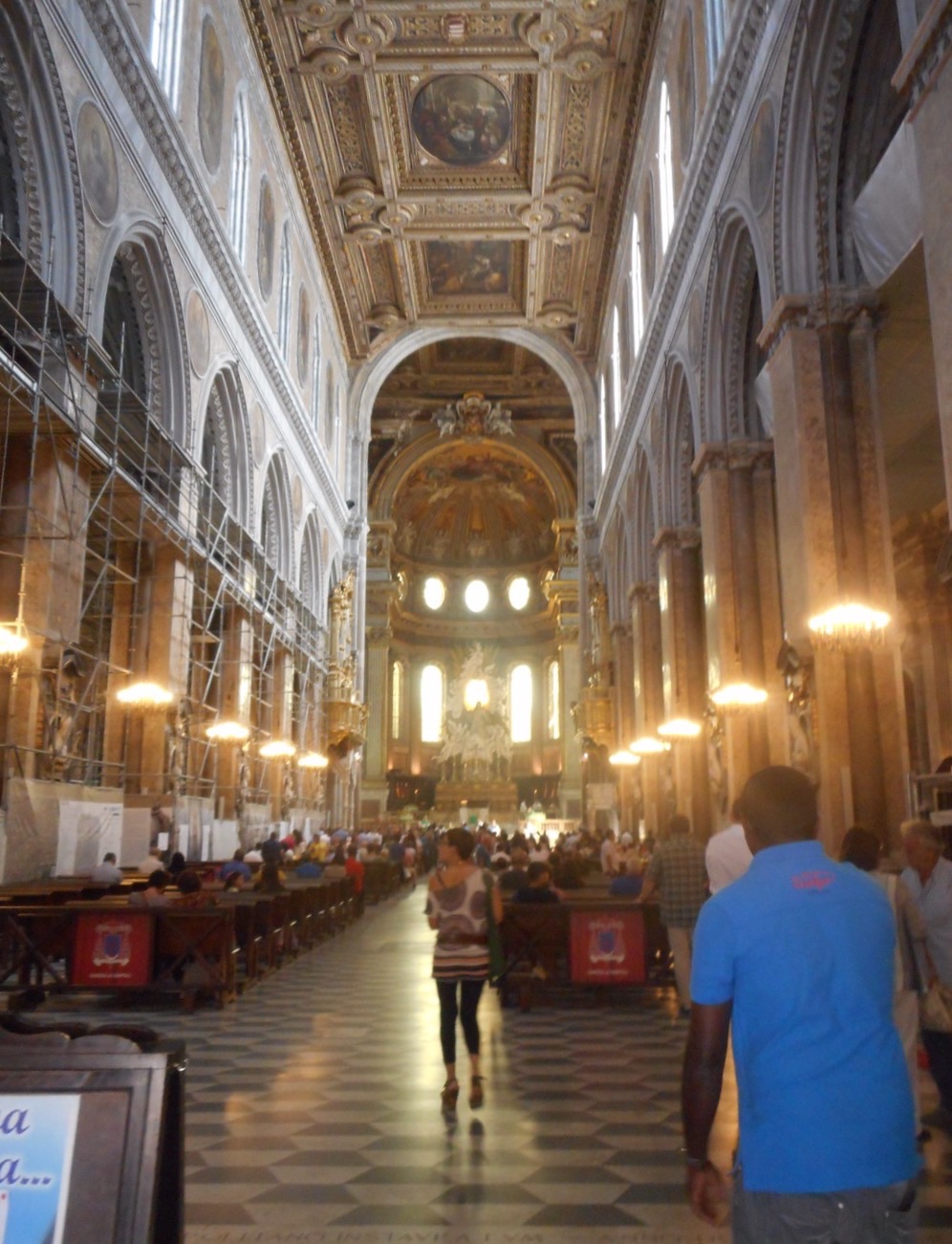
Today being Sunday, day 2 here, I trotted around the corner to the Duomo for nine o’clock Mass in the Chapel of San Gennaro.  S. Gennaro was a martyr who was executed in Pozzuoli in 305 A.D., and whose blood apparantly liquifies miraculously every year on September 19.  That happens to be next weekend, the day we’re supposed to leave Naples. Pozzuoli isn’t Naples, but no matter, close enough.  Naples has adopted him.

The Chapel is beautifully painted and full of items of the “Treasure of San Gennaro”, silver candelabra, and other items of value and art.  Look at the floor of the photo on the right, below.  Even the floor is inlaid with three colors of marble in a precise design.

image image

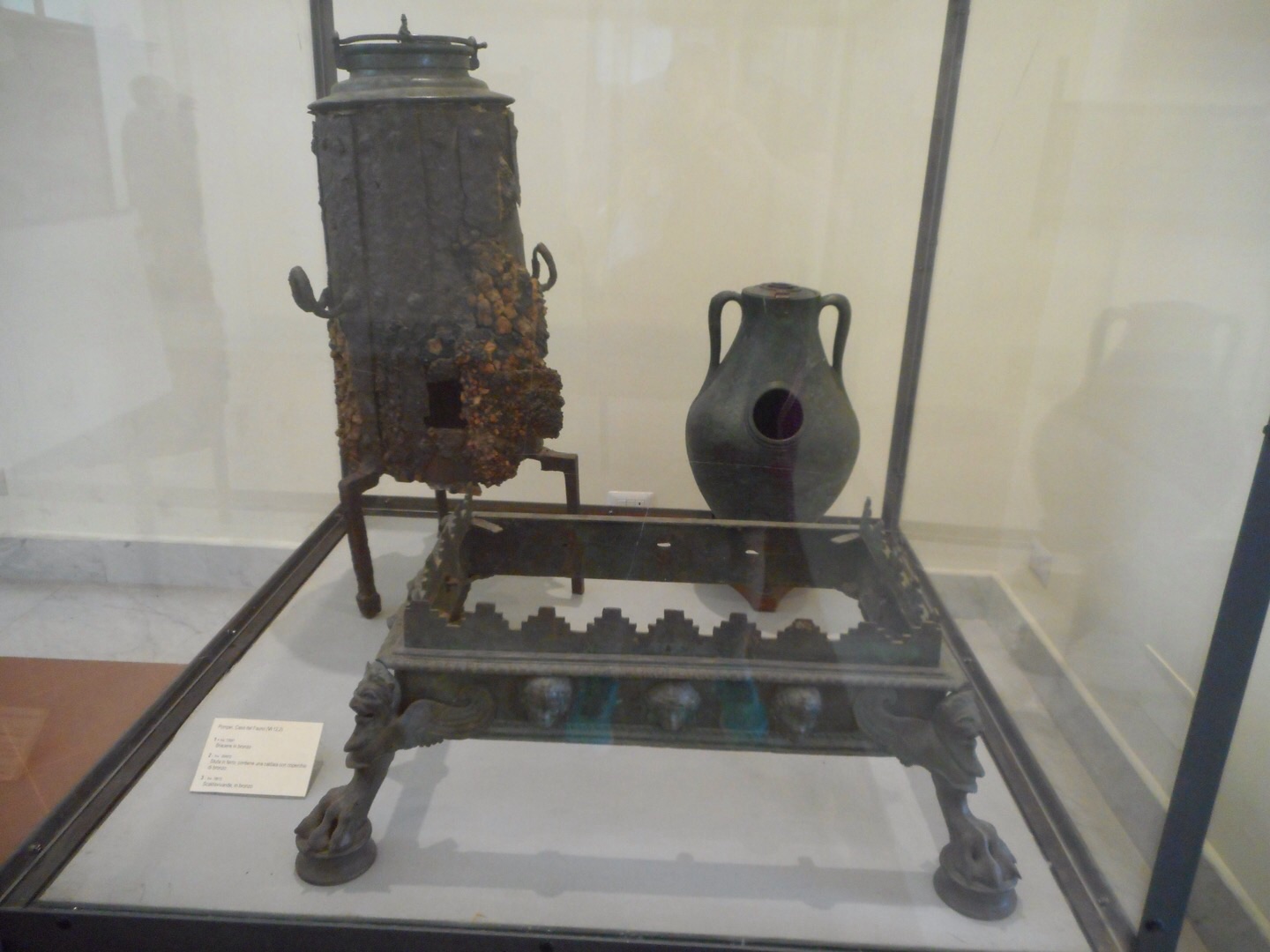
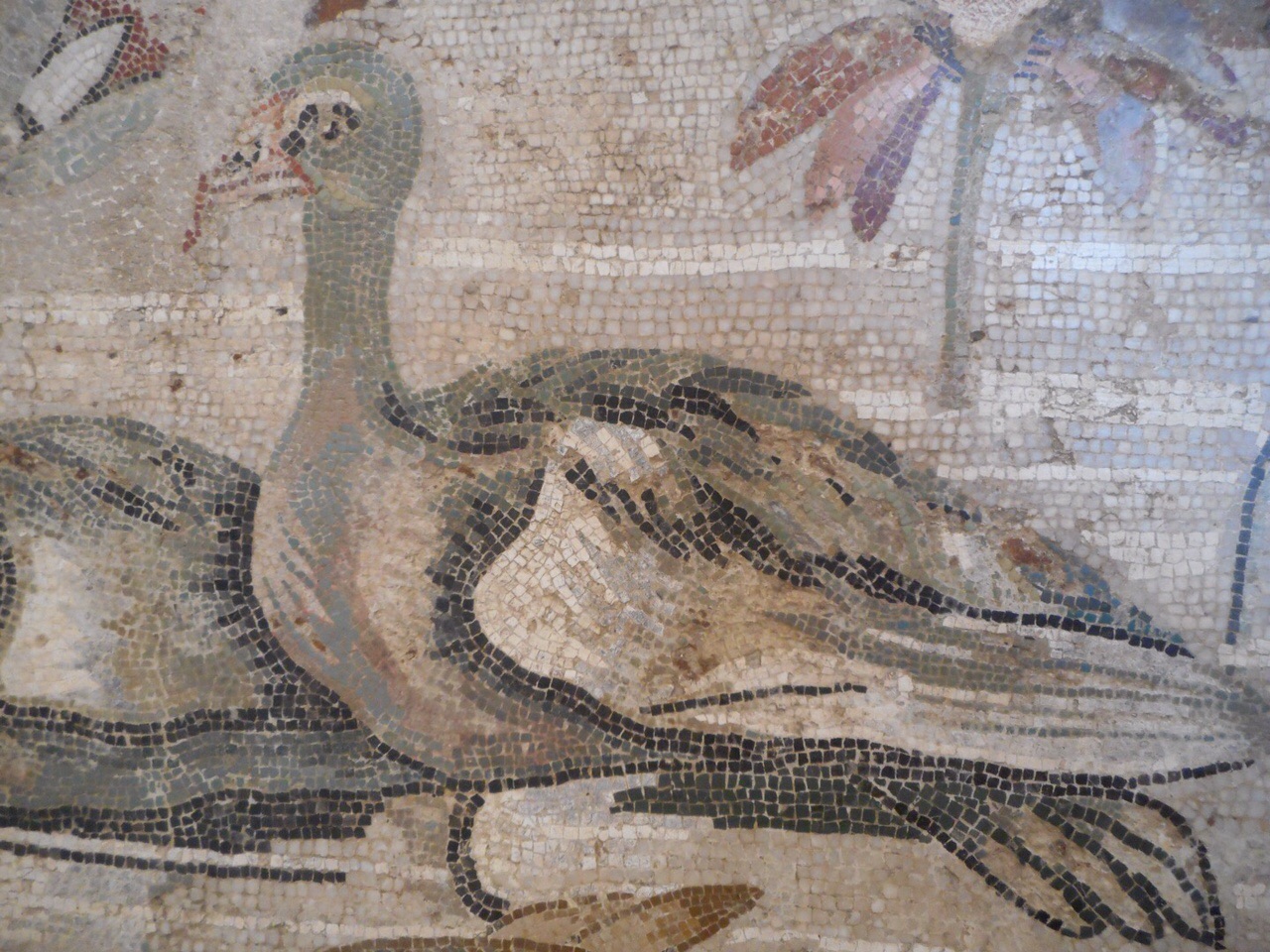
When I got “home”, we set off for the Naples Archaeological Museum.  It has a great collection of ancient sculpture and some Egyptian artifacts, as well as an exhibition of hundreds of items from Pompeii, which were looted by collectors, before people realized that we would all understand much more about these things if we could see where they had been, in context.  The mosaics were very intricate at times, being made up of so many tiny pieces that if you stand just a few feet away, they are as subtle as paintings.  I hadn’t realized that mosaic had ever been used so finely.

The museum had a lot of interesting items, but was poorly curated.  There was no guide to the museum, except for one we found afterwards in the bookshop, for 12 euro.  Since the entrance had cost 13 euro already, it’s unlikely we would have forked out so much for a guide.  But all that was available was a poorly xeroxed plan of the museum, with numbers in each “room”, and no indication of what might be there.  I had to go back to ask what floor we were on, since you can enter on so many levels in these huge Italian buildings, I couldn’t tell if I was on the ground floor or the first.  There were no signs directing you to one floor or the other, you just had to wander around.  Having said that, it was definitely worth a trip, and I would even put it at the top of the list.

image image image

All of these items came from Pompeii.  The last image is of braziers and stoves found in one of the houses.  Amazing that they should still be intact.

When we came out of the museum, we were accosted by a well-spoken young man, who offered to walk us to the restaurant he worked for, where, he assured us, we would have a great lunch.  Rob and Audrey agreed to go with him, so we tagged along, and he was right;  we were off the main road in a quiet side street, in the shade, and had salads and light, white wine.

Then we went home and I had a two-hour nap.  Tomorrow:  Capri.

Day 6: Castiglioncello and the beach

Swimming in the Tyrennian Sea!  What an experience.

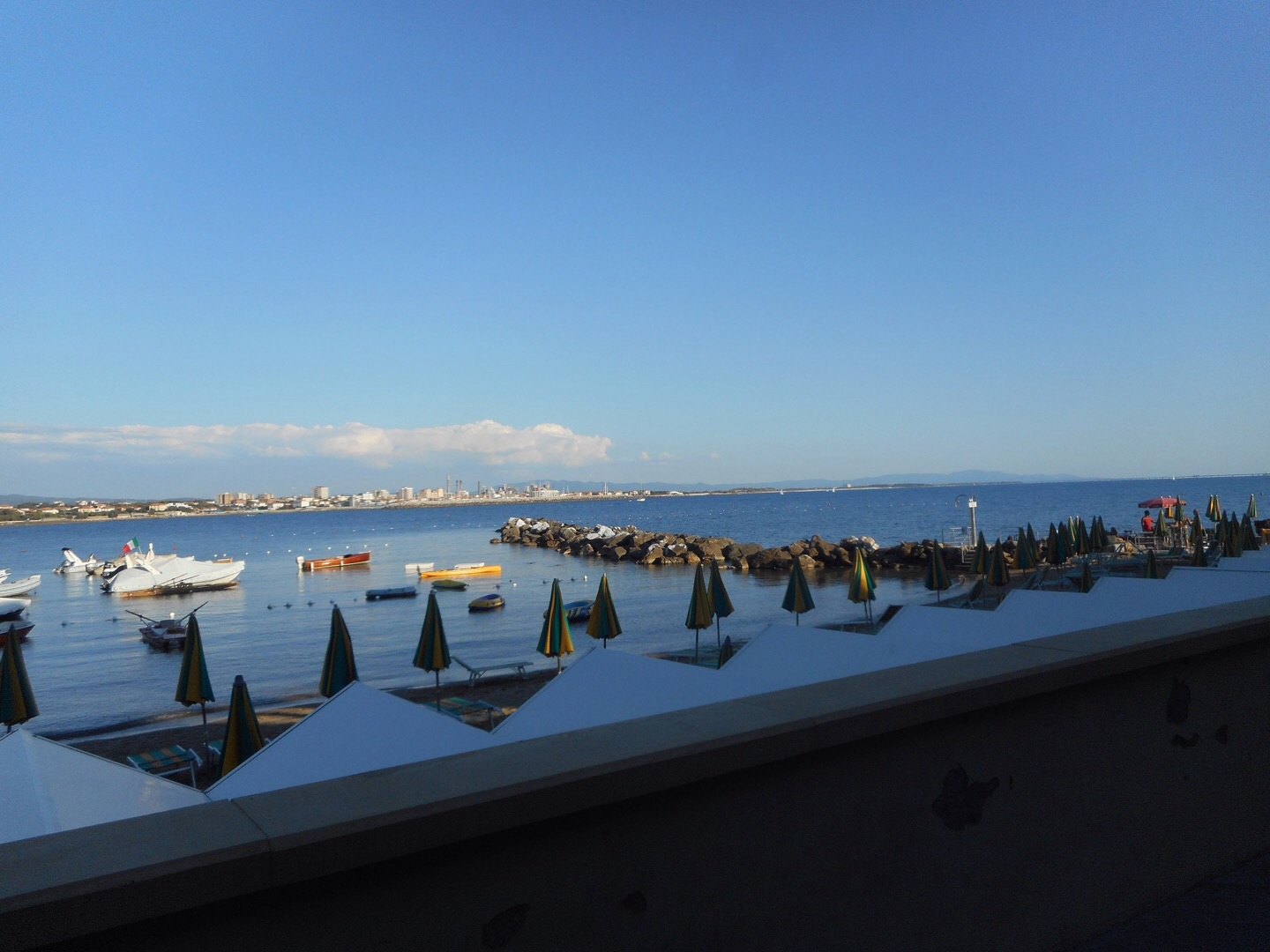
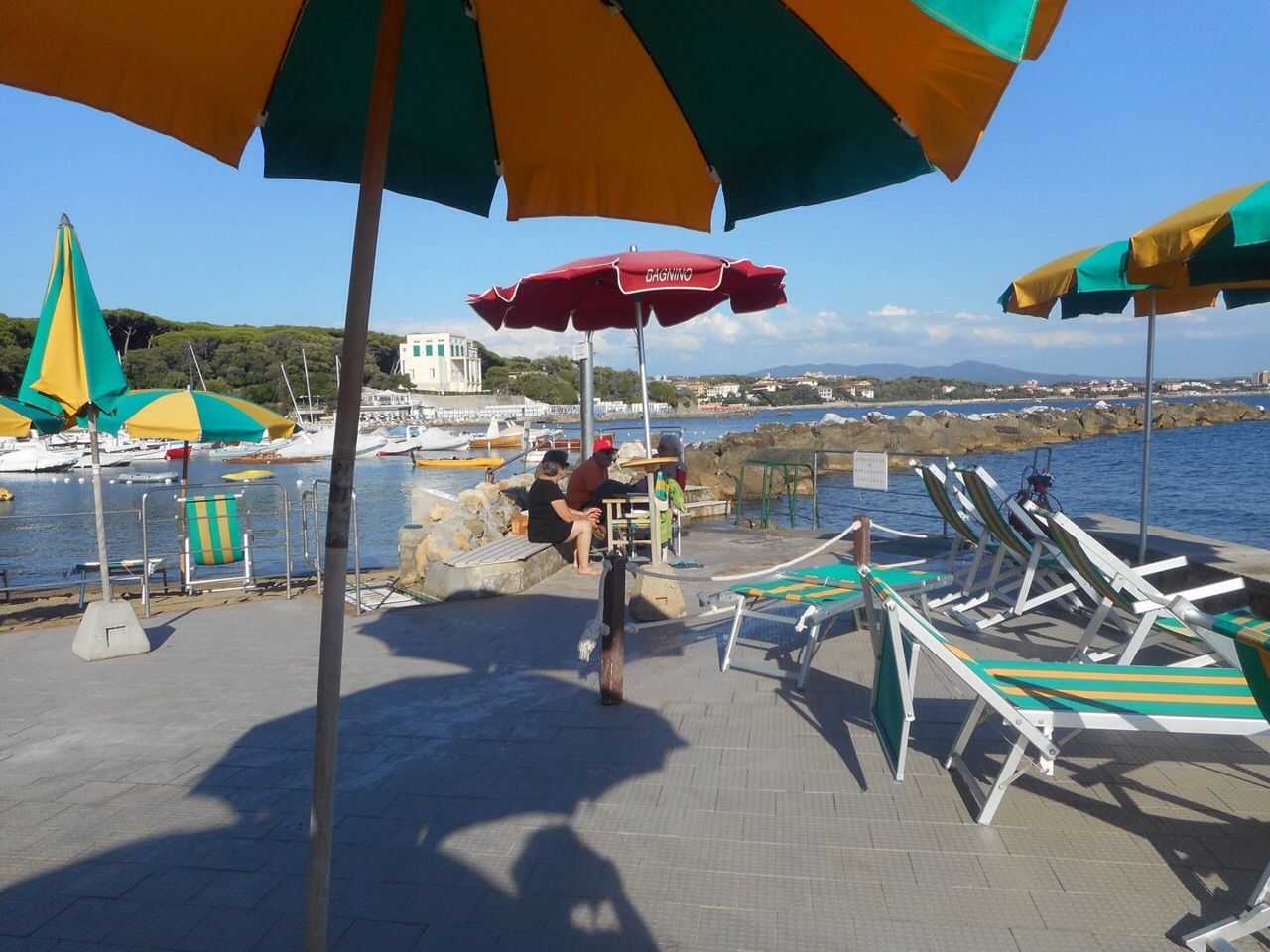
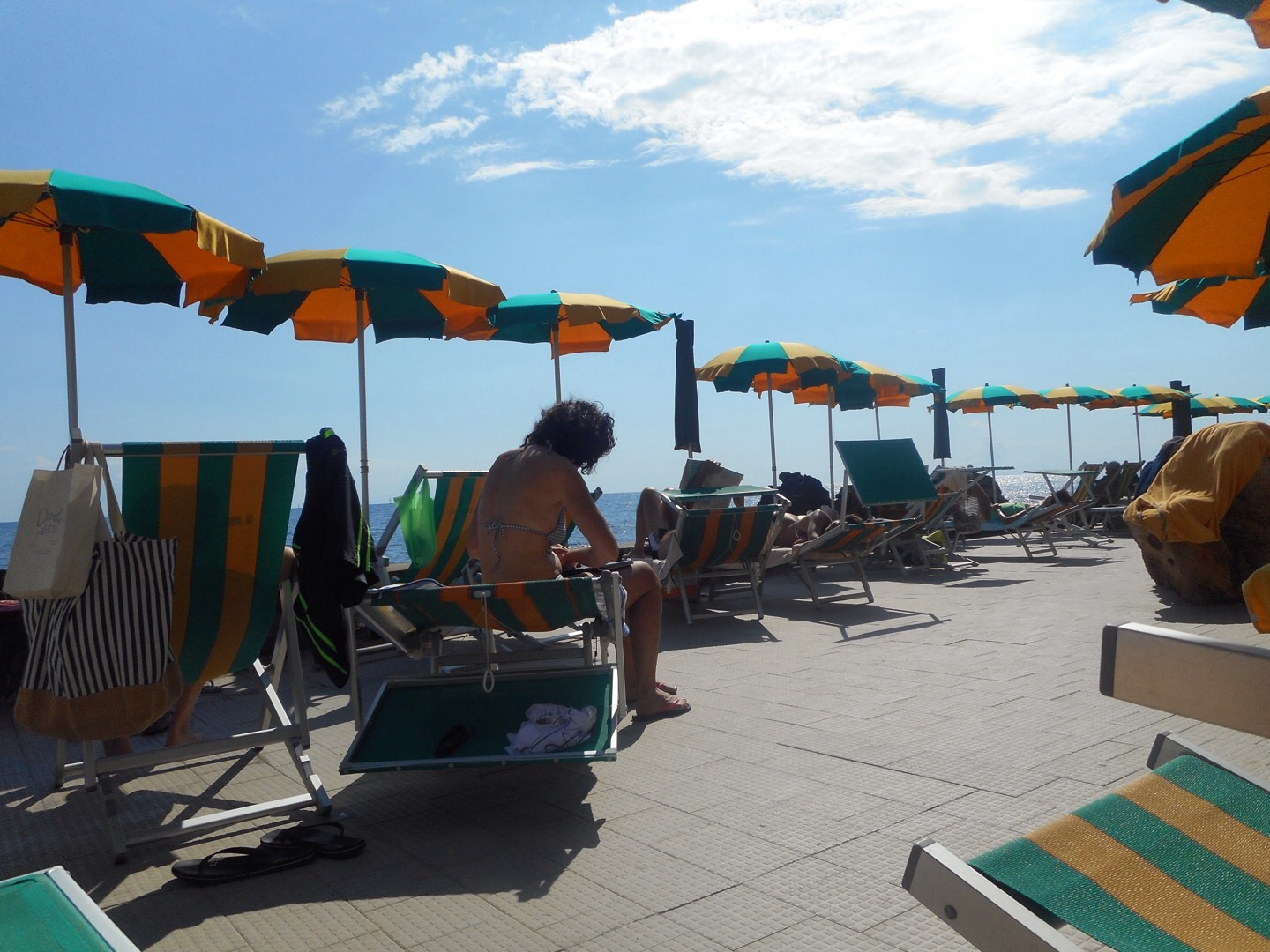
Our Italian hosts own the concession on a small strip of beach and rocky coast in Castiglioncello, about half an hour south of Livorno, and we were driven there today for a relaxing day by the sea.  The town is a small, chi-chi resort, which was the preferred vacation spot for a host of movie celebrities in the 50’s and 60’s.  Marcello Mastroianni had a house there, a golden palazzo perched on rocks overlooking the sea (you pass it on the way into town from the north), and the neighborhood is full of fine private houses used by many of their owners as summer homes.

An Italian beach concession means that you pay to get onto the beach.  If you’re a resident, you can purchase a membership for a season, including a cabana, or tiny cabin, which you can use for changing or storing beach supplies.  That will run you a few thousand euros a season.

Castiglioncello 1 image Castiglioncello 2 image

The concession supplies beach umbrellas and a choice of chair or “bed” .  We were met by our hosts, who generously supplied us with chairs and umbrellas.  This stretch of coast has acres of sharp rocks which reminded me of the California coast in spots.  Audrey and I took a walk along the water above the rocks on a nice flat path built by the town, until it petered out after about 200 meters, and we faced rock.

Getting into the water was possible from the sandy beach or into 4 foot deep water, down a ladder directly into the sea.  Sticking one toe into the water made me decide on the sand, until I realized the water wouldn’t even come up to my knees until I got in amonst the boats in the adjacent marina, so I changed my mind and climbed down.  The water was incredibly clear and bottle-green.  Tiny fish swam around my feet.  The bottom was full of large rocks, and you had to stand on them, going from rock to rock, or take off and swim.  The cold went away quickly, and the water was beautifully refreshing, the sea looked so blue, and we could see sailboats a few hundred yards out.

It was our last day in Livorno, and that evening we were again hosted by our hostess, her brother and his girlfriend, a sumptuous meal including fried zucchini flowers, cutlets of beef from the family’s cousin’s farm, and beautiful wines, some home-made.

It was hard to say good-bye after such a great week, but I have to think that our hosts need a rest after all they did for us.  I hope we’ll stay in touch with them – they are a great, loving family.

Day 5: Florence, Day 2

Today was the day for the Uffizi, or Offices, once the administration center of Florence.  Now an art gallery, it’s basically two buildings linked by a common colonnaded courtyard, situated on the Arno River, and a stone’s throw from the Ponte Vecchio.  In fact, the tale is told that the top floor of the Ponte Vecchio formed a private walkway for one of the Borgias to walk from his home to the office, without mixing with the common folk, or even (horrors!), getting wet in the rain.

In any case, lines were again predictably long, but since we had our vouchers, not bad for us.  We went through a security check, which didn’t seem too vigorous, and started the heart-attack-inducing climb up the many, many staircases to the upper floors which house the exhibitions.

When you finally puff your way to the top (I admit to having to stop once), you find yourself in an ornately painted corridor, off which are various rooms containing paintings and sculptures of various periods.  Along the corridor are sculptures from the Roman Imperial period;  the ceiling and walls of the corridor are brightly and intricately painted.  Along a narrow shelf, high up, is a line-up of a rogues’ gallery of sorts, paintings of important personages in the history of Florence.  One room of the corridor held a wealth of paintings by Botticelli, including the beautiful Birth of Venus.

Another room held one painting by Michelangelo, and others by contemporaries, which gave a quick comparison of the difference in their styles.

The windows from the gallery looked out on Florence along the river, and the city probably would be recognizable to a Borgia who showed up unexpectedly for work today.  Unfortunately, I will have to get some photos from Tom to insert here, because for some reason, all of mine from this day of walking have gone awol.

By the time we had walked about 10 miles around the Uffizi, strolled around more of the city, just soaking up the atmosphere, and had lunch, we were all about ready to call it quits.

There’s a great deal we still haven’t seen.  Next time, I would visit the Pitti Palace and Boboli Gardens, and spend more time walking the old streets.  Florence, even in September, is crowded, so you might think of planning your visit for the end of the month, or even the beginning of October.

Travels in Italy 2015

No one ever asks, “Why are you going to Italy this summer?”  It’s more than obvious:  so much to see, so many adventures to have, so much food to eat.  The stars really seem to have aligned for us this summer;  our friends Rob and Audrey have friends in Livorno, who have generously put a vacation apartment at our disposal;  Rob and Audrey were as sick of the cold and snow in the Northeast as we were, and we decided it would be fun to travel together.  As it turned out, our summer in Ireland has been one of the coldest and wettest in more than twenty years, while Italy, we hear, is basking in brilliant sunshine.  Good decision.  In about 36 hours, Tom and I will fly from Dublin, Ireland, to Pisa.  It’ll be great.